Thursday, March 26, 2020

Learning from Jacob and Enos, a wise father and son

I often thought about Enos while I was studying and teaching from the New Testament last year. He didn't contribute many words to the Book of Mormon but he showed great faith. The one chapter that he wrote was invaluable. While I was studying Jacob 5-7 and Enos over the last two weeks, these are the things that struck me the most.


1. The reiteration of the importance of what they were doing with recording and focusing on what their descendants needed to read and learn from their records.

Lehi, Nephi, Jacob, and Enos likely didn't imagine the concept of the printing press and copy machines, let alone digital copies. They knew they were writing for others to read and learn but were they able to understand the scope, that their words would translated and printed over and over again and brought to all the lands?

Nephi stated that they were writing this book to "persuade men to come unto the God of Abraham, and the God of Isaac, and the God of Jacob, and be saved." (1 Nephi 6:4). Yet, I wonder if he realized that he would be persuading many so many generations later. These words were being written and guarded by single individuals! How simple, from a father (Lehi) to a son (Nephi) to a brother (Jacob) to a son (Enos).

When we think of this being such a personal thing, how does that apply to you? Do you keep a journal? If so, do you make sure to write down the insights and the moments that turned you closer to God, and to having a clear focus on what you are doing in this life? There is a very popular professor at the University of Utah, that goes by the name of Dr. Abe. He shares that he writes in his journal daily, then reviews it at the end of the week, pondering what he has learned, what he can do better, how he served in the world around him. It makes the written word so meaningful and purposeful. How can we be like the faithful Lehi, Nephi, Jacob, and Enos?

2. The faith the followers of God showed in going into the wilderness, recording the records, and following instructions that they didn't always fully understand. 

In Jacob 4:10, Jacob advised, "Wherefore, brethern, seek not to counsel the Lord, but to take counsel from his hand. For behold, ye yourselves know that he counseleth in wisdom, and in justice, and in great mercy, over all his works."

When Jacob was nearing the end of his life, he concluded his record by sharing the faith it took to live his life, stating, "I conclude this record, declaring that I have written according to the best of my knowledge, by saying that the time passed away with us, and also our lives passed away like as it were unto us a dream, we being a lonesome and a solemn people, wanderers, cast out from Jersualem, born in tribulation, in a wilderness, and hated of our brethern, which caused wars and contention; wherefore we did mourn out our days." (Jacob 7:26).

When Enos subsequently inherited the plates to share he told his story about praying fervently, and how his "soul hungered" (Enos 1:4) and how he "cried unto him in mighty prayer" (Enos 1:4). The Lord answered Enos' prayer for forgiveness, then Enos prayed for his people. He prayed sincerely, with great desire for forgiveness from the Lord, and as a result, the Lord spoke to him in his mind, and Enos said, "my faith began to be unshaken in the Lord" (Enos 1:11).

3. The importance of being good parents and good examples to others.

Enos starts his records by calling his father, "a just man - for he taught me in his language, and also in the nurture and admonition fo the Lord - and blessed be the name of my God for it." (Enos 1:1). This reminds me of the opening verse to the Book of Mormon, written by Enos' uncle, Nephi, "I Nephi, having been born of goodly parents, therefore I was taught somewhat in the all the learning of my father ..." (1 Nephi 1:1).

When Lehi had a vision and shared it with his family, Nephi showed respect to his father by first listening to him, but then faithfully praying himself to learn what his father had learned.

These were good children that were motivated by good examples in their lives. Of course, there were those, like Laman and Lemuel, who chose not to follow the great example they were given but they were all given the opportunity to choose.

4. Missionary work
Some recurring things jumped out at as me as well, from studying the New Testament last year and what Lehi, Nephi, and Jacob already stated in previous chapters.

The theme of missionary work was on my mind as American missionaries from around the world are trying to make their way home (as a safety precaution and a response to the Covid-19 pandemic). I have several nephews that have made the difficult trek back, stuck in airports waiting for new flights to open, and not knowing exactly where they are going to be in a day, or a month from now.

Yet, no matter how they serve and where they serve, they follow the direction from Jacob in Jacob 1:7, "Wherefore we labored diligently among our people, that we might persuade them to come unto Christ, and partake of the goodness of God, that they might enter into his rest ..."

Yet, like the people in Enos time, they continue to serve in faith, even when sometimes "our strugglings were in vain in restoring them to the true faith."

Conclusion
We are living through a difficult trial right now, with a lot of unknowns regarding the progression of Covid-19. Luckily, we have prophets, past and present, that can guide us through these trying times. I'm astounded by the new things I learn from them every time I read their words. I look forward to their continued wisdom as I navigate the world we live in today, and as I listen to Jacob, who advised, "O, be wise; what can I say more?" (Jacob 6:12).


Sunday, March 15, 2020

Come Follow Me - Sunday School (2 Nephi 31-33 and Jacob 1-4) - Be Reconciled Unto God

Even though we are not meeting as a class in the church building on Sunday (See Church News, 12 March 2020), I'm sharing some of the slides I prepared for the adult Sunday School lesson that I was scheduled to teach. These slides are not meant to be viewed in order but to jump around based on our class discussion and inspiration. I hope they add to your pondering and discussions at home! (Click on any image to see a larger version of the slide.)


The last two weeks of Come Follow Me cover chapters written by Nephi and Jacob. I am fascinated by Jacob who spent his childhood, youth, and early adulthood traveling through the wilderness.

In 2 Nephi 31-23 we learn that "Jesus Christ and His Doctrine are the Only Way to Eternal Life." 


As quoted in the Adult Sunday School manual, Elder Jeffrey R. Holland explains this further:


We can gain inspiration in our daily lives as we ponder what this mean. I like the reminder above that Elder Holland shared in 1997 above paired with a Facebook post he published last month:


How can you personally seek the path to eternal life? What areas do you need to work on? How have you been inspired by others on the path to eternal life?


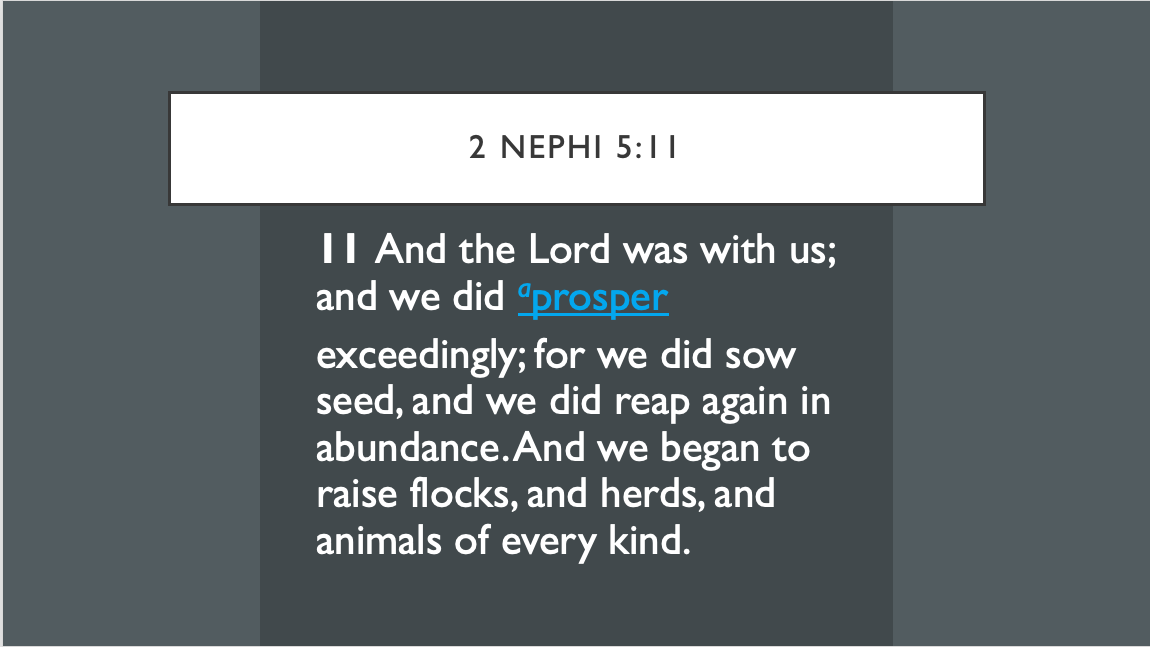
In 2 Nephi 31:15-20, we study that "He that endureth to the end, the same shall be saved." This made me think about 2 Nephi 5:11, that the blessings that come, come with work. That we reap the fruit of the seed that we sow. I added that on the right in the slide below to be viewed alongside President Uchtdorf's insightful words in 2007: 


In 2 Nephi 32:1-6, we learn about how the Holy Ghost instructs us. Nephi understood this well, and chastised his older brother in 1 Nephi 15:8-11 for not understanding this. Again, this goes back to the previous slide, where we discuss that the blessings require effort.


Jacob 1-4

I've skipped over a number of slides that just don't make sense without discussion. Moving on to Jacob 1-4, the next lesson, Jacob talks about how we can "Be Reconciled to God through the atonement of Christ."

I love this image of King Benjamin speaking from a tower so that more people could hear him. He is one of my many scripture heroes, as he was "truly good without guile." We study in the Come Follow Me for Individuals and Families manual about our own worthiness in the Lord's eyes to magnify our callings, and we see how righteous leaders like Jacob did this for his people. Jacob was so faithful. He grew up in the wilderness, wandering for the first part of his life, and listening to his older brothers - not just Nephi, but Laman and Lemuel undoubtedly had opinions and shared them in his presence. However, he was unfaltering in choosing the Lord.


Thinking about Jacob, and of course, the Savior, and how all of these great people magnified their callings while here on earth, what did we learn from them? What do we learn from our leaders today, in all their "humanness"?


Images: King Benjamin | Lehi | Jesus | Enos


My favorite way that I have seen leaders magnify their callings is in small and simple things - remembering the names of all of their flock. I remember moving into this area and meeting a brother in the ward that I didn't know even know knew my name, and he asked how my husband and I were doing, by name. Later, when he was called to be the bishop, I already felt he was someone that cared about others individually.

I love President Henry B. Eyring's talk, "Rise to Your Call," that he gave in October 2002. He says, "Your call has eternal consequences for others and for you. In the world to come, thousands may call your name blessed, even more than the people you serve here. They will be the ancestors and the descendants of those who chose eternal life because of something you said or did, or even what you were."


In Jacob 2:12-21, Jacob talks about being careful of pride. 

In verse 13 he warns, "you have obtained many riches; and because some of you have obtained more abundantly than that of your brethern ye are lifted up in the pride of your heart ... and persecute your brethern because ye suppose ye are better than they." He continues to verse 18-19, "But before ye seek for riches, seek ye for the kingdom of God. And after ye have obtained a hope of Christ ye shall obtain riches, if ye seek them; and ye will seek them for the intent to do good ..."

The Sunday School manual references an excellent talk from Elder L. Tom Perry:


I also thought this set of scriptures about "looking beyond the mark," would lead to valuable discussion:


I highlighted four points from Elder Cook's talk, and I think this slide alone could be used for an entire one-hour discussion, or even just one of the four blocks that I created:

(“Looking beyond the Mark,” Ensign or Liahona, Mar. 2003, 42–44).


While I'm disappointed that I didn't get to have a discussion with the class and hear all of their amazing and spirit-led insights as they read the scriptures, pondered the lesson, and were inspired in class, I'm grateful to have read the words of Nephi and Jacob in these scriptures, and been blessed by their insights. I have more studying to do on Sunday around these scriptures and am excited to "feast upon the words of Christ" further.

Sunday, March 8, 2020

Notes from Relief Society today - Learning to sail our ships

In Relief Society today we focused on "Knowing, Loving, and Growing," by Elder Hans T. Boom, a talk from October 2019 General Conference that I have quoted in the past, when we were studying Ephesians in the Bible and learning about how to Strengthen Families. In addition, we studied "The Second Great Commandment," by President Russell M. Nelson, from October 2019 General Conference.

We had a great discussion, and I was mostly focused on just listening to it but I did jot down a quote, and another quote that I found as a result of the lesson. Lastly, I drew a little picture showing a girl who was inspired to bring a watermelon to a woman she barely knew, but it was exactly what the pregnant, lonely woman was craving. Listen to the Lord, and follow promptings to help others in need.


In the above referenced talk, President Nelson stated:
Latter-day Saints, as with other followers of Jesus Christ, are always looking for ways to help, to lift, and to love others. They who are willing to be called the Lord’s people “are willing to bear one another’s burdens, … to mourn with those that mourn; … and [to] comfort those that stand in need of comfort.”3
They truly seek to live the first and second great commandments. When we love God with all our hearts, He turns our hearts to the well-being of others in a beautiful, virtuous cycle.
"In Knowing, Loving, and Growing," Elder Hans T. Boom says:
We all know where we can do better. There is no need to repeatedly remind each other, but there is a need to love and minister to each other and, in doing so, provide a climate of willingness to change.

Friday, March 6, 2020

Teaching and Reviewing Book of Mormon Stories

I subbed for the Primary Choristers in our ward last week. We reviewed and learned the song "Book of Mormon Stories." Our choristers want to sing this song in this order: vs. 1, 4, 7, 2.  This was SO FUN, and went by so fast.

I basically put on a mini play where we sang each verse of the song while kids held up props or acted out their role.

What I Liked About this Singing Time
  • Great participation. Several kids that are normally too shy to get up and participate in the front of the room willingly came to the front of the room!
  • Teachers involvement. I handed them copies of the lyrics their class would be involved in, and had them decide what to hand out to each child and "direct" the kids. I like having teachers participate in Singing Time when possible.
  • Fun way to learn the song.
  • Kids learned the words fast. It was definitely aggressive to cover all four verses at once but I wanted to make sure every child had a prop and an opportunity to participate. I don't regret doing it this way because it was so fun but it would definitely be helpful to have a second week to reinforce each verse. 
  • (I can see Week 2 being something fun like - hand out all the pieces, not by class, and have it be a game for the kids to figure out when to stand up. I might just have them stand without coming to the front so they aren't too intimidated by this game. OR, have kids come up and ask the class to "unscramble" them and put them in the right order before the verse ends. I would NOT do a full repeat but I would incorporate a bunch of the same stuff, somehow.)
How it Worked
I prepped a prop bag for each of the verses of the song.  Below is a list of the props for each verse, pictures of some of the props for that verse. I explain further what I did below the lists of props for each of the four verses.

Also, in case you are wondering, for safety issues, and since I don't have permission from the children's parents to post their pictures, I've blurred out everyone's faces in the pictures :)


Verse 1
1. Gold plates I had made previously (but you could use a real Book of Mormon)

2. Headbands - one for a Lamanite, one for a Nephite, and one for Jaredite. (Make a bunch of these for a big class. I opened to the first page of the Book of Mormon and explained that this song was a little misleading because it says it's "all about the Lamanites from ancient history" and its actually tells about the Lamanites, Nephites, and Jaredites. I would have spent a little more time here but I was worried about time. In hindsight, I could have given it one more minute but I was worried about time, and it did go by very quickly. I didn't want to risk one class not being able to go up.

To make the headbands, attach long strips of paper together, then cut slits on the ends so they can be closed around the head and adjusted to different sizes. I laminated mine.

3. I cut out some blue paper in a zig zag for "sea" and laminated it.

4. I cut out and laminated a half circle to represent a boat.

5. A poster board that said "CTR" for "righteously"


Verse 4
1. Abinadi's chains.

I linked paper together with a stapler to make a chain for the bound Abinadi. I labelled the wrists and ankles so it would be easy for the child to know which end went where, and I also made the ankle chains much wider to slip more easily over feet. "Abinadi" had the "chains" around his ankles earlier but had taken them off by the time this picture was taken, unfortunately. He was wearing boots so he had to take his shoes off to get the chains on. It was my favorite prop and so easy to make!

2. A gold crown for King Noah.

I cut little tabs into the crown so it was easy to size for different children's head sizes.

I had "King Noah" raise his fist and make an angry face when we sang that part. The kids loved it, and it was fun to see a shy, sweet girl pretending to be angry in Junior.

3. A poster board that said "CTR"

4. A picture of Abinadi standing before King Noah

This was mainly because this song didn't lend to as many props.

5. Fire!

I laminated together orange and yellow paper to look like fire and had the kids holding the fire move their fire in front of Abinadi during that part of the song. I very quickly reminded them that Abinadi died by fire, but he died righteously.


Verse 7
1. A chair for Samuel to stand on for the "city wall" (Yes, this little girl is standing on a chair.) I LOVE how her teacher is helping her. Yay for teacher participation!!

2. A headband for Samuel (actually I didn't make one because I was planning to include my Bible garb but I forgot it)

3. Blue arrows that I laminated.

This is an opportunity to make a bunch of arrows to make sure kids have enough props. In Junior Primary, each child had an arrow and just pretended to throw it.

In Senior Primary, two children each had multiple arrows, and they threw them at Samuel. It was awesome because since the arrows were just laminated paper, they really couldn't hit Samuel.

4. A poster board that said "CTR" (for "righteously"). I briefly explained why we were using the poster.


Verse 2
1. Headbands that said "Lamanites" on them. Again, this is a chance to make multiple headbands for a bigger class.

2. Book of Mormon

3. Hearts. The hearts represent being brothers. I made two for the class size. Make multiple here.

4. A poster board that said "CTR."

Making Assignments with the Prop Bags
I reviewed the class list and how many children I thought would be there on Sunday to determine which class got which props, since some verses lent themselves to more visuals. I also planned to move one child to another class if necessary but everything worked out so that I didn't need to do that. The key is to make sure you have more props than you think you will need. No child left behind!

Having a separate bag for each verse made it easier to quickly hand a group of props to each class. In some cases, I combined classes. I made sure to review the roster beforehand, but then did a quick count of each class as they came in to see who was missing that day and if that impacted which bag I wanted to give a class.

I also didn't want the Sunbeams to go first because I thought that it being so early in the year, they might still be a little shy (depends on the class every year!) so if they saw another class go first, they might have a better understanding of what was going on, and be more willing to come up. I had several Sunbeams that came up that have been too shy to participate as of yet so I believe this theory was correct. The nature of the participation was a little less intimidating as they were up there with their entire class, got to see everyone else do it first, and were preoccupied with their props.

Other Thoughts
While it's fun to act out the traditional motions to "Book of Mormon" stories I feel that some of the motions are outdated and not accurate to the cultures they represent. For example, in the Book of Mormon, and in pictures that artists have depicted, I have not seen any evidence of Lamanites with two feathers (two fingers) sticking out of headbands. This way of singing the song was an easy way to avoid the popular motions but not in a way that the kids would miss them.

Just to be clear, I know the motions are beloved and still well remembered by many of the choristers that teach them. I understand, and love the nostalgia and sentimentality there. I thought this was a fun way to move further into the gospel of the song, though.

Also, it's a great opportunity to share you testimony. I did not do this in Junior Primary because I ran out of time but in Senior Primary, I let them know that as fun as it was to sing these songs, for me they were powerful because I know and believe that they really happened, and are a witness to us of the prophets that came before our time.


Sunday, February 16, 2020

Teaching Nephi's Courage - Let the Kids Make Up the Motions - KIDS LOVE THIS AND LEARN IT FAST!!!

Hi Friends, 

I first published a post about teaching Nephi's Courage in 2012 and noticed a LOT of traffic to it this weekend (thousands of visitors) so I wanted to share a little more about the BEST WAY TO TEACH THIS SONG.

Since 2012, I've served as Primary President for almost six years, and have seen this song taught more than once. Of all the songs I taught, and all the ways I taught it and saw it taught, this one was my favorite song to teach and my favorite way to teach a song.The kids LOVED it and learned it SO FAST, even the Sunbeams. 

I had three different choristers during my years as Primary President that were and are all seriously AMAZING music teachers, and surprisingly, this was the one teaching method that I used that I never saw repeated! So I want to make sure it's in your teaching tools. And, there's NO PREP WORK except to KNOW YOUR SONG, which is a given.

All I did was asked the children to help me make up motions for each part of the song rather than teaching them a motion. They loved being able to participate in this way and they learned it VERY fast. The only trick was that you have to remember if you are teaching this song in Junior and then again in Senior, that you may need to remember and use different motions for the different classes. I jotted down a few notes after I sat down to help me remember but if you teach the song again the following Sunday, the kids can help you remember the motion, too, especially the kid that came up with the motion that you are using.


How it works:

Chorister: [Assuming you have already discussed the first line of the song. If not, introduce it as described here.] "I want you to help me teach this song. I'm going to sing the first line of this song with the chorister, and I want you to listen carefully so you can help me think about a motion we can make with our hands to remember that line. For example, if the song was about a tree, I might go like [this] with my hands. Or if the song was about a heart, I might go like [this]." 

Chorister and Pianist: [Sing the first line with the pianist.] Okay, what motion do you think we should use for "The Lord commanded Nephi to go and get the plates?" 

Involving Kids: At this point, you can either call on a kid, or encourage kids to show the motion they suggest and pick the best one, or encourage children to raise their hands, and show you their motion. If the motion is really weird, ask them why they chose it. Sometimes the reason is really good, even if it's not intuitive, and you should use it! Sometimes, the motion makes no sense, and then you can gently prod them - "That's a great idea but let's do something that will remind us of a book, because plates are like a book. Do you have a motion for a book?" If they are still struggling, ask them to choose between three good options. Try to be flexible here though. If the motion isn't inappropriate, try to use it though. You want to encourage your children, and by asking why they chose that motion, you can usually find that their reasons were good behind their creative young minds. They get so excited to be able to help here. Also, try to focus on kids that don't get called on a lot. I remember I had a weird motion for "said it would not float" but the little kid explained that he was turning is hand over to show the boat tipping over, so I went with it. 

Okay, you now have one line, with one or two motions to represent that line.

Chorister: "Great, let's sing just that line with that motion." (For example, it could be pointing at the sky for "Lord commanded" and then putting hands in front of you like your hands are book for "to go and get the plates.")

Chorister and kids: Sing that line with that motion.

Chorister: Okay, let's talk about the next line of the song. [Sing the line with the pianist:] "From the wicked Laban behind the city gates."

Chorister: "What motion can we use to show the wicked Laban behind the city gates?" 

Kids come up with a new motion for the new line.

Chorister: "Okay, let's sing the first line and the second line."

Keep going, starting over from the very beginning after you add each line. This gives you repetition, which is one of the greatest tools in memorizing when you can do it in a FUN way. They learn it SO fast, but they're having fun because they're participating!

Chorus:
Keep the chorus simple, I pump my arms back and forth for "I will go, I will do, the things the Lord commands, ... He helps me to obey."

When the kids were reverent enough, we marched back and forth in their rows for this part, too. They were good about sitting down when we got to the first line of each new verse, then standing back up to march when we got to the fun end part. Everyone loved this, Sunbeams through 11.


2 Nephi 1-10: Mercy, Obedience, and the Atonement

I taught adult Sunday School today. This is a portion of the slides I created for class - not all of the slides were used in class, and not all of the slides that were used in class are in this post, either, but these are the ones that I felt translated the best without as much discussion. You can click on any of the images to see a bigger version of them. I also re-typed some of the quotes directly above or below some of these slide images.

This first slide shows who was speaking in each of the first ten chapters of Nephi and to whom they were speaking. It's helpful to understand that context to understand where Lehi or another individual focused their conversation, same as it is in the New Testament with understanding the difference audiences they were speaking to, especially Paul, as he traveled throughout the region and talked to folks with different religious backgrounds. It's also important to remember that they had a precious amount of space on these metal plates, and Jacob felt it was important to use that space to quote Isaiah, which he goes on to do past chapter 10, but this post only covers 2 Nephi 1-10.


These slides show what they were talking about in each chapter:


Some of the themes that really jumped out for me were:
  • The Lord is merciful.
  • We will be blessed IF we keep the commandments.
  • Overcoming afflictions - and sometimes that means fleeing them.
  • Happiness and prosperity means working at something.
  • We should not fear man more than God.
  • Parallels to the teachings and experiences of Christ, Paul, Peter, and other leaders in the New Testament.
  • The atonement.
Examples:


Here's some background I gave on where Lehi traveled and what that land looked like:

There are a number of maps here: 

from a 1976 trip to discover the path that Lehi's family took, traveled and researched by Lynn M. and Hope A. Hilton (go to the link to see the full pictures):


From “Was Lehi Here?” by David A. Edwards – January 2008
Be sure to read the above link for full details as these pictures just give a high level view.
There are also additional photographs at that above link.


Some of the scriptures that we talked about:


There was an excellent comment about how clearly these scriptures lay out the opposites, that even a child can quickly grasp that we can't understand happiness without sorrow, that there is opposition in all things. (There were many excellent comments, but since I was teaching I unfortunately did not have the opportunity to jot them all down.)


I'm re-typing this since the font is so small below. This is from "Our Campfire of Faith" from Elder Gerrit W. Gong in October 2018 conference:

"When we have felt, or feel, uncertain, alone, frustrated, angry, let down, disappointed, or estranged from God and His restored Church, it may take an extra measure of effort and faith to enter again on His covenant path. But it is worth it! Please come, or come again, unto the Lord Jesus Christ! God’s love is stronger than the cords of death—temporal or spiritual.10 Our Savior’s Atonement is infinite and eternal. Each of us strays and falls short. We may, for a time, lose our way. God lovingly assures us, no matter where we are or what we have done, there is no point of no return. He waits ready to embrace us."


In Nephi, we saw the Lord repeatedly giving his people guidance when they were obedient. In some cases, when the burdens became too great, and after multiple chances, the Lord directed them to flee. I thought this was interesting because I've experienced this with making the decision to leave a job, after many attempts to try to resolve a bad situation. The key here is not being a quitter, but knowing when to try to live through the afflication and when to flee. 


Sources for images:
Pioneer Handcarts:
Moses parts the red sea:
Lehi and his people:
The brother of Jared:


In Nephi's case, there came a point when the Lord told him to flee. For example, see 2 Nephi 5:4-5:


I found and read this wonderful talk in the course for preparing this lesson:  "Our Strengths Can Become Our Downfall," by Elder Dallin H. Oaks given in October 1994 at a Brigham Young University Fireside.

He gives a number of specific examples of how if we are not comfortable, something that could be a strength in our life could become a chink in our armor against the adversary. 

He says:

"How, then, do we prevent our strengths from becoming our downfall? The quality we must cultivate is humility. Humility is the great protector. Humility is the antidote against pride. Humility is the catalyst for all learning, especially spiritual things. Through the prophet Moroni, the Lord gave us this great insight into the role of humility: 'I give unto men weakness that they may be humble; and my grace is sufficient for all men that humble themselves before me; for if they humble themselves before me, and have faith in me, then will I make weak things become strong unto them.'" 

I loved this entire talk, and because it was given at a BYU address, it didn't reach the greater audience at General Conference, so I want to encourage everyone to read "Our Strengths Can Become Our Downfall!"


Some of these slides are not saving over well so to re-quote from the slide above, from the talk "Taking Upon Ourselves the Name of Jesus Christ,":

"Finally, I believe that to take upon ourselves His name, we must trust Him. At a meeting I attended one Sunday, a young woman asked something like the following: “My boyfriend and I recently broke up, and he chose to leave the Church. He tells me he has never been happier. How can this be?”
The Savior answered this question when He said to the Nephites, “But if [your life is] not built upon my gospel, and is built upon the works of men, or upon the works of the devil, verily I say unto you [you will] have joy in [your] works for a season, and by and by the end cometh.”22 There simply is no enduring joy outside the gospel of Jesus Christ."


I created this timeline because the powerful thing about what Jacob shares here is that every moment shows the Lord's mercy. 


The Lord showed mercy in:

1. Sending prophets to warn Jerusalem to repent.
2. Warning Lehi that since nobody was repenting, they needed to go into the wilderness.
3. Guiding Lehi's family into the wilderness.
4. Sending the Savior to give the people that rejected the prophets another chance.


We are blessed because we learn from our trials and afflictions, and because for whatever else we cannot overcome, the Lord blesses with our obedience through the plan of atonement. Says Elder Jeffrey R. Holland, in "Where Justice, Love, and Mercy Meet:"

"What a plight! The entire human race in free fall—every man, woman, and child in it physically tumbling toward permanent death, spiritually plunging toward eternal anguish. Is that what life was meant to be? ...
"The answer to those questions is an unequivocal and eternal no! With prophets ancient and modern, I testify that 'all things have been done in the wisdom of him who knoweth all things.'4 Thus, from the moment those first parents stepped out of the Garden of Eden, the God and Father of us all, anticipating Adam and Eve’s decision, dispatched the very angels of heaven to declare to them—and down through time to us—that this entire sequence was designed for our eternal happiness."


2 Nephi 9


50 Come, my brethren, every one that thirsteth, come ye to the waters; and he that hath no money, come buy and eat; yea, come buy wine and milk without money and without price.
51 Wherefore, do not spend money for that which is of no worth, nor your labor for that which cannot satisfy. Hearken diligently unto me, and remember the words which I have spoken; and come unto the Holy One of Israel, and feast upon that which perisheth not, neither can be corrupted, and let your soul delight in fatness.