Showing posts with label Hope. Show all posts

Sunday, December 13, 2020

Moroni 7-9 "May Christ Lift Thee Up" - Faith, Hope, and Charity in a Difficult Year

After the Lamanites destroyed the last of the Nephites, and Moroni, the only survivor, said those poignant and heart-breaking words, "... for I am alone, My father hath been slain in battle, and all my kinfolk, and I have not friends nor whither to go ..." (Mormon 8:5), what happened to him?

For one thing, he didn't die as soon as he expected. I think he found great comfort in reading the words of Ether, a man that was also hiding in the wilderness and recording the records of his people, just like Moroni. When we reach Moroni 7-9, and Moroni shares some of the things that his father Mormon had taught or written to him. Moroni had great faith in his Savior, Jesus Christ. He had his own faith, and he had the faith of great men like Ether and his father Mormon to further bolster him so that he was alone but not alone.

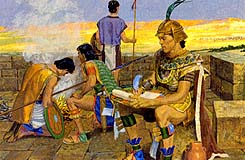
Moroni Hides the Plates in the Hill Cumorah
by Tom Lovell

This year, I have spent time interviewing my parents and learning their stories. Most recently, I learned that my great-grandfather died after being drafted into World War II. I learned that as a boy, my grandfather's family lived in an area so remote that they had to move to a village when they decided to put him in school as a child. I learned about these generations that came before me, before my father became the first in his family to move to America, where he raised my family.

I think about how fascinating it has been to learn about my parents and their parents, and then I read the Book of Mormon and think about how this is our heritage too, that these records were written for us, that we could learn from them. And that they are written about their neighbors, their fathers, their brothers, and, though rarely mentioned, their mothers, wives, and sisters. 

Knowing that Moroni was all alone, and that the was reflecting on the words of Ether and of his father Mormon, and that at this point, he was surprised to still be alive, makes what he focused on in Moroni 7 all the more meaningful, as he talks about faith, hope, and charity. 

Regarding charity, Moroni 7:8 says, "For behold, if a man being evil giveth a gift, he doeth it grudgingly; wherefore it is counted unto him the same as if he had retained the gift; wherefore he is counted evil before God."

Those words are harsh but think of it as the spirit of the law vs the letter of the law. If your neighbor offered to help you with a project, but you learned that the entire time they were helping you, they were railing against you in their head, judging you, and thinking poorly of you, would you still want that help? Isn't part of what feels good about that help believing that someone cares about you and is gladly helping you to lift a burden? And having their company with you? When you take away the heart and leave only the mechanics, it doesn't feel like a service or a kindness. In fact, if you see what they were thinking, you would feel worse after receiving help than better. Thankfully, that's a worst case scenario but it's one to think about as you are "anxiously engaged in a good cause."

Sharon Eubank, in the talk "By Union of Feeling We Obtain Power with God," from October 2020 General Conference, said: "Jacob 2:17 reads, 'Think of your [brothers and sisters] like unto yourselves, and be familiar with all and free with your substance, that they may be rich like unto you.' Let's replace the word substance with mercy - be free with your mercy that they may be rich like unto you. We often think of substance in terms of food or money, but perhaps what we all need more of in our ministering is our mercy.'"

Moroni 7:45 says, "And charity suffereth long, and is kind, and envieth not, and is not puffed up, seeketh not her own, is not easily provoked, thinketh no evil, and rejoiceth not in inquity but rejoiceth in truth, beareth all things, believeth all things, hopeth all things, endureth all things." 

I've see a lot of sickness around me this year. Not just from Covid-19 itself but from people more focused on being angry about how they are being personally inconvenienced by the pandemic. These struggles are real and I fully recognize that but everyone has been struggling in one way or another, we have all been impacted in one way or another, and how we choose to internalize these scriptures, how we choose to find empathy and charity in our life, will change our perspective on how we handle our trials.

In the talk, "Wounded," from October 2018, Neil L. Anderson said, "The wounded who nurse the wounds of others are God's angels on earth." 

Henry B. Eyring, in the talk, "Tested, Proved, and Polished," said, "... we must notice the tribulation of others and try to help. That will be especially hard when we are being sorely tested ourselves. But we will discover as we lift another's burden, even a little, that our backs are strengthened and we sense a light in the darkness."

Although I have seen a lot of sickness around me this year, I've thankfully also seen a lot of healing. 

Some examples:

  • Near the beginning of the pandemic, a restaurant (Magleby's) that suddenly found business was slow was able to afford to keep paying their employees, and had them go serve other businesses in the hospitality business that had been impacted by Covid. So, they kept employees employed, and rather than benefiting themselves, they tried to help other struggling businesses. They could have been upset that they were suddenly leaking money everywhere but instead, they looked around, saw that they had enough, and went looking for who else they could help.

  • My sister took her two oldest children and playing music for a woman that had become a widow right before the pandemic began, and was now being isolated right at the time when she needed people around her the most. The widow watched from her open door while my sister and her kids stayed more than 6 feet away, with large instruments (including a cello) that they had lugged down the street to set up in front of her house. Not only did this widow appreciate the music but the widow's children, who worried about their mother, felt encompassed by an action that was based on mercy and love. I share this example because I personally read the notes that this widow's family posted on Instagram, but I know this isn't an isolated example of kindness. 

Moroni said it perfectly in Moroni 8:16: "for perfect love casteth out all fear."

Moroni promises in Moroni 7:16, "the Spirit of Christ is given to every man, that he may know good from evil" and in Moroni 7:12, "in Christ there should come every good thing."

Moroni 7:29 promises us, "have miracles ceased? Behold I say unto you, Nay; neither have angels ceased to minister unto the children of men." 

In the talk, "I Believe in Angels," by Carlos A. Godoy, he says, "The Lord is always looking for willing volunteers to be angels in other's lives."

There are angels in heaven, and angels on earth. As we work to have faith, hope, and charity, may we be an angel on earth for others, may we be "faithful in Christ" so that we can lift others up as Christ lifts us up. (Moroni 9:15).

I'm thankful for this Christmas season and for the gifts we have been given. I'm thankful that through my faith in the Lord Jesus Christ, I can have hope and that I can follow him and be both the giver and receiver of charity.




Sunday, August 23, 2020

Book of Helaman 1-6 - Come Follow Me - "The Rock of Our Redeemer"

A quick summary of key events in Helaman 1-6:

  • These six chapters cover years 40-68 of the reign of the judges. 
  • There are SEVEN chief judges during this period because five are murdered as a result of greed and pride
  • Kishkuman and the Gadianton robbers slowly began to infiltrate the land with their secret combinations and murders. This led to Nephite dissension, which led to the successful Lamanite invasion.
  • After Moronihah (the son of Mosiah) was only able to get back 50% of their land from the Lamanites, the Lamanites and Nephites began to freely travel between the lands and trading commerce with each other.
  • Lehi and Nephi, the sons of Helaman (who was the son of Helaman, who was the son of Alma), preached for the rest of their days. As a result, many Lamanites were converted to the Lord.
  • The Lamanites became increasingly good. The Nephites became increasingly bad. 
  • The Lord protected Lehi and Nephi when they entered the land of Nephi to preach to the Lamanites and were thrown in prison. More Lamanites were converted. 
  • The Lamanites eradicated the Gadianton robbers instead of listening to them and became increasingly meek and humble while the Nephites listened to the robbers and began to join with them in "their secret murders and combinations." (Helaman 6:38)

By the time we reach the writings of Helaman, the Nephites had lost and regained land to the Nephites three times over 15 years. Each time this happened, many people died. 

The Come Follow Me manual refers to how this happened as the "pride cycle," in which the Nephites were so blessed for obeying the commandments that they became very prosperous, forgot how they reached that level of success, began to fight with one another, and weakened themselves to the point where the Lamanites could come in and destroy them. Then, they remembered, repented, were blessed, and began to prosper yet again. 

(Click to enlargen): 


A recent example of the pride cycle (click to enlargen):


How Do You Overcome the Pride Cycle?
When I think about this, I look at the physical and spiritual gifts that the Lord has blessed me with and whether I have become lifted up in pride, or whether I am seeking to use my gifts to further the work the Lord, serve others, and bring beauty into the world. A little exercise to consider: Write done five blessings in your life. Write down how you have used them for good. Then write down how you can work on them this year, to use them for good. Moroni was a master strategist and blessed the Nephites with his skill and thinking. He never forgot the Lord and the inspiration the Lord gave him. It never occurred to him to use his skill to crown himself king, yet this thought occurred to many others (Paanchi, Kishkumen, Gaddianton, Amalickiah, all of the kingmen, to name just a few). In fact, in Alma 60:36, Moroni says, "I am Moroni, your chief captain. I seek not for power, but to pull it down. I seek not for honor of the world, but for the glory of my God, and the freedom and welfare of my country."

Moroni asked Pahoran for help https://www.churchofjesuschrist.org/study/friend/1994/11/captain-moroni-and-pahoran?lang=eng

In Helaman 3, we see that in the 48th and 49th year of the reign of the judges that there was so much peace throughout the land that "there was exceedingly great prosperity in the church." However, by the 51st year, after only a few years of prosperity, pride "began to enter into the church - not into the church of God, but into the hearts of the people who professed to belong to the church of God - And they were lifted up in pride, even to the persecution of many of their brethern" (Helaman 3:34-35). It's a bold reminder to watch ourselves and how quickly we can forget.

Trials and Hope
What about those that were humble and faithful throughout, the ones that never fell prey to the pride cycle, the people of Ammon who remained true to their covenant not to lift their weapons; Helaman, Moroni, Teancum, Lehi, Nephi, and so many more that were not named? They had to live through those wars and see their people slaughtered by the Nephites, too, even though they were obedient. 

It says in Helaman 3:34 that the pride of others caused "the more humble part of the people to suffer great persecutions, and to wade through much afflictions."

It says of the humble followers of God: 

"Nevertheless they did fast and pray oft, and did wax stronger and stronger in their humility, and firmer and firmer in the faith of Christ, unto the filling their souls with joy and consolation, yea even to the purifying and the sanctification of their hearts, which sanctification cometh because of their yielding their unto God." (Helaman 3:35).

We cannot live this life without trials and anguish but I find great comfort in knowing that the the Lord is always waiting and encourage us to remember him. We can remember the words that Helaman taught his sons:

"And now, my sons, remember, remember that it is upon the rock of our Redeemer, who is Christ, the Son of God, that ye must build your foundation; that when the devil shall send forth his mighty winds, yea, his shafts in the whirlwind, yea, when all his hail and his mighty storm shall beat upon you, it shall have no power over you to drag you down to the gulf of misery and endless wo, because of the rock upon which ye are built, which is a sure foundation, a foundation whereon if men build they cannot fall." (Helaman 5:12).

Sunday, July 19, 2020

Alma 32-35: Alma Taught the Zoramites Faith, Humility, and Prayer

Ten days ago, a six-year-old boy threw himself in front of his four-year-old sister when a German shepherd began charging them. They had just entered the backyard of the home that their family was visiting when the dog began to charge them. The six-year-old successfully protected his sister, while being bitten in the face, a wound that required 90 stitches to close.


I first read this story on KSL News, where it stated that in the account repeated by his father, the boy, Bridger Walker, said that “after the dog bit him, he yelled for his sister to run away; and when the dog released his grip, he ran to his sister, leading her to a safe part of the yard.” 

I thought of this boy’s bravery and sacrifice as I read Alma 32-35 in the Book of Mormon. If I were to summarize each of the four chapters of Alma 32-35 in one word per chapter, the words I would choose are: humility, prayer, prepare, and faith. In summary, these chapters are about Alma preaching to the poor among the Zoramites who had not been allowed into the synagogues to worship. Alma taught that if we humble ourselves before God, if we understand that we can pray to him anytime, anywhere, and if we listen and prepare for the day when we will one day meet God and be held accountable for how we have lived this life, our faith will make us whole. In these chapters, many people turned away from the incorrect beliefs they had been following in order to turn to God. They were persecuted for their beliefs and had to leave their homes to find somewhere to worship safely.

Faith
I compare these themes and stories to this boy’s faith and how he had been taught. His family had studied the scriptures and in a Sunday discussion shortly before the attack, talked about personal sacrifice and service. Bridger knew what was important to him, his family. His sister was smaller than him, and he made his decisions without hesitation.

Remember, Bridger was only six, and while suffering from a wound that required 90 stitches, his top-most thought wasn’t calling for help, or how much he hurt, or if he was scared, it was making sure that his sister was safe. The heroism is even more significant when you realize that the boy thought he might die. In the hospital, the boy explained to his father, “If someone had to die, I thought it should be me.” 

The faith that leads to sacrifice and service comes in all shapes and sizes. It doesn’t always have to be a big, grand gestures, and it is often thankless and unnoticed, like Alma and the sons of Mosiah that earnestly taught about God in lands where they weren’t always welcome and like the followers of God that had to give up their homes to worship safely.

Alma 32:21-22 says, “21. And now as I said concerning faith - faith is not to have a perfect knowledge of things therefore if ye have faith ye hope for things which are not seen, which are true. 22. And now, behold, I say unto you, and I would that ye should remember, that God is merciful unto all who believe on his name; therefore he desireth, in the first place, that ye should believe, yea, even on his word.”

The worshippers of God showed faith that by choosing the right way they would be doing the right thing, and that was what what mattered the most. Little Bridger showed faith in the stories of sacrifice and service that his father had taught, and did what he felt was the right thing, and that was what mattered the most.

Humility
One of the big themes of this set of scriptures is humility, and how we are blessed for our humility, even more so when we are humble by choice instead of by circumstance. Alma 32:16 says, “Blessed are they who humble themselves without being compelled to be humble.” The poor had become humbled in these scriptures because they were deprived of the right to worship, and while that humility led them to the truth, Alma taught that it would be even better if they were humble out of choice.

The story about Bridger’s heroism was first shared by family members on social media but as the story has gained momentum, people have reached out to contribute to bills. I admire the humility of the family in stating that they weren’t seeking gain, and instead prayerfully identifying three charities that they asked people to consider donating to instead (Mission 22, Operation Undergroud Railroad, and The Wounded Warrior Project).

Prayer
At no point did Bridger’s family blame the family friends whose yard Bridger and his sister entered before the dog attacked Bridger. Instead, they asked those reading about their story to include the owners of the dog in their thoughts and prayers, expressing their love for that family.

Alma 33 focuses on prayer and how it is welcome to all. It quotes the prayer of the prophet Zenos, as he recounted to the Lord in prayer that he was able to prayer to him in the wilderness, in his field, in his house, in his closet, and no matter where, the Lord heard his prayers. 

The scriptures are of great hope. They share that even if we have just a little bit of hope, a little bit of faith, if we nurture it like a good seed, it will grow. In Alma 33:23, Alma concludes the chapter, “And now, my brethren, I desire that ye shall plant this word in your hearts, and as it beginneth to swell even so nourish it by your faith. And behold, it will become a tree, springing up in you unto everlasting life. And then may God grant unto you that your burdens may be light, through the joy of his Son. And even all this can ye do if ye will. Amen.”

Friday, August 9, 2019

Romans 1-6 - Trials and Patience (Section at the end for children/music)

For those studying the New Testament this year alongside Come Follow Me: For Individuals and Families, this week's study is Romans 1-6. I'll be teaching about the book of Romans in a couple of weeks so for now, I'm focusing on my reaction as I read these set of scriptures.

The Pattern of the New Testament
I have been fascinated with the way the different books of the Bible roll together. This is obviously too succinct of a description to do it justice but I would classify my experience as:

  • Section 1: The Gospels (Matthew, Mark, Luke, John): Jesus teaches in parables.  He also taught by example and how he lived his life, plus the experiences of his 12 disciples. Trying to learn the parables through listening to his audience try (and sometimes fail) to understand them is incredibly insightful.
  • Section: 2: Acts (The Acts of the Apostles): It's the forming of a team! Just like some of my favorite recent movies about the Avengers, The Guardians of the Galaxy, etc, a rag tag team of individuals with their own strengths and flaws come together and form a powerhouse of good. That's where we meet Saul who became Paul, who plays a pivotal role in later books in the New Testament.
  • Section 3: Romans: Paul teaches us. Suddenly, I feel like I'm at General Conference. I'm listening to a leader try to knock some sense into me because he wants me to have the best life I can by blessing me with guidelines, trying to help me understand the power of the gospel, and sometimes send some stern admonishments. 

To distill this down even further, it's:
Parables -> A serge of missionary work -> Paul preaches

Again, obviously, it's way deeper and more energizing than that, but I'm speaking in terms of overall patterns as I study the scriptures.

What Paul Taught Me this Week
First, it was helpful to read the Come Follow Me lesson this week and understand that Paul wrote many of the epistles to Saints in the church that comprise the New Testament, and that Romans was actually written toward the end of his journey. Think of our beloved President Nelson. He's a very wise man but his wisdom has only grown, and we rely on his latest lessons even more so than things he taught 20 years ago, though of course, we listen to that advice, too!

Second, I went into the scripture study thinking about some frustrating things that I was dealing with at work. I love my job and what I do, and have great managers and colleagues - though like these wonderful disciples and leaders, they (and I) are not perfect. I was recently put into a very stressful situation at work by leaders that trust me to be able to navigate the rough waters but it felt (feels) like an almost impossible situation. I began reading Romans with this situation in the back of my mind, and some hope that the scriptures would give me answers and comfort.

After reading through Romans 1-4, this is what jumped out at me when I reached Romans 5:3-5:

"And not only so, but we glory in tribulations also: knowing that tribulation worketh patience; And patience, experience; and experience, hope; And hope maketh not ashamed; because the love of God is shed abroad in our hearts by the Holy Ghost, which is given unto us."

I tend to scoff a little when I hear people say they pray for adversity in their life because I have yet to meet someone that said, "Hey, I was just diagnosed with [insert bad thing here]. I'm so glad the Lord answered my prayer for adversity." No, instead, they immediately turn around and beg for that bad thing to go away. So ... I do appreciate the adversity I have had in my life but in hindsight only. I don't enjoy it or feel particularly grateful when it's happening to me, and I certainly don't court it. I feel humbled. I feel grateful for the Lord. I'm not gonna lie - I want that bad thing to Go. Away.

In Acts, Paul was falsely accused, had false witnesses lined up against him, was imprisoned, was even bitten by a snake. He had a falling away with his good buddy, fellow disciple Barnabas, who had defended him when he first converted. Life was tough! However, he understood this concept of patience and hope, and it made him a better man.

Several years ago, I had one of the worst two years of my life because of a very bad work situation that lasted a very long time and bled into my personal life because I was so stressed and unhappy about the work situation. It was a lead ball that I dragged around with me even after I left work for the day. It was pretty horrible. However, Paul teaches:

tribulation =  patience
patience = experience
experience = hope

Therefore, tribulation ---> hope.

I saw this in action. A year after I left that terrible work situation, I ended up in another frustrating work situation, with colleagues that were also frustrated. We discussed our situation often and it was clear to me that while we were all frustrated, I seemed to be handling it a little better. I was mad but their morale was so low I saw it change their personalities - as had happened to me from my previous trial. These were smart colleagues that I greatly admire - how could I handle this any better than them?

I firmly believe that I had had enough of the same kind of tribulation that I had learned the tribulation -> patience -> experience -> hope aspect, at least for that specific troubling situation.

I hope you're following me. This is a very long ways of me trying to explain that for every tribulation we experience, we gain greater hope, and my testimony that I personally witnessed this to be true.

Hope, well ... it gives me hope. It makes the bad things I'm dreading ahead a little easier to process.

"And we know that all things work together for good to them that love God, to them who are the called according to his purpose." - Romans 8:28-29.

How does this apply to children?
Talk to the children about what it means to have faith like Paul in understanding that good things can come out of bad things (i.e., patience can come out of tribulation) and have children share songs that come to mind for them that talk about this. Or, go the opposite and have children choose slips of paper that have these songs written about this that help teach your point. You can either use hints to see if the children can guess the song and then sing it, or you can sing the song with children and ask them to identify what it has to do with learning about faith, patience, and hope from Paul in Romans.

Songs with sample hints/topic lines:

When I Am Baptized
"I can be forgiven and improve myself each day."

Faith
"Faith is trust in God above;
In Christ, who showed the way."

"Faith is strengthen; I feel it grow
Whenever I obey"

Nephi's Courage
"I will go; I will do the things the Lord commands.
I know the Lord provides a way."