Showing posts with label 2 Nephi. Show all posts

Sunday, March 15, 2020

Come Follow Me - Sunday School (2 Nephi 31-33 and Jacob 1-4) - Be Reconciled Unto God

Even though we are not meeting as a class in the church building on Sunday (See Church News, 12 March 2020), I'm sharing some of the slides I prepared for the adult Sunday School lesson that I was scheduled to teach. These slides are not meant to be viewed in order but to jump around based on our class discussion and inspiration. I hope they add to your pondering and discussions at home! (Click on any image to see a larger version of the slide.)


The last two weeks of Come Follow Me cover chapters written by Nephi and Jacob. I am fascinated by Jacob who spent his childhood, youth, and early adulthood traveling through the wilderness.

In 2 Nephi 31-23 we learn that "Jesus Christ and His Doctrine are the Only Way to Eternal Life." 


As quoted in the Adult Sunday School manual, Elder Jeffrey R. Holland explains this further:


We can gain inspiration in our daily lives as we ponder what this mean. I like the reminder above that Elder Holland shared in 1997 above paired with a Facebook post he published last month:


How can you personally seek the path to eternal life? What areas do you need to work on? How have you been inspired by others on the path to eternal life?


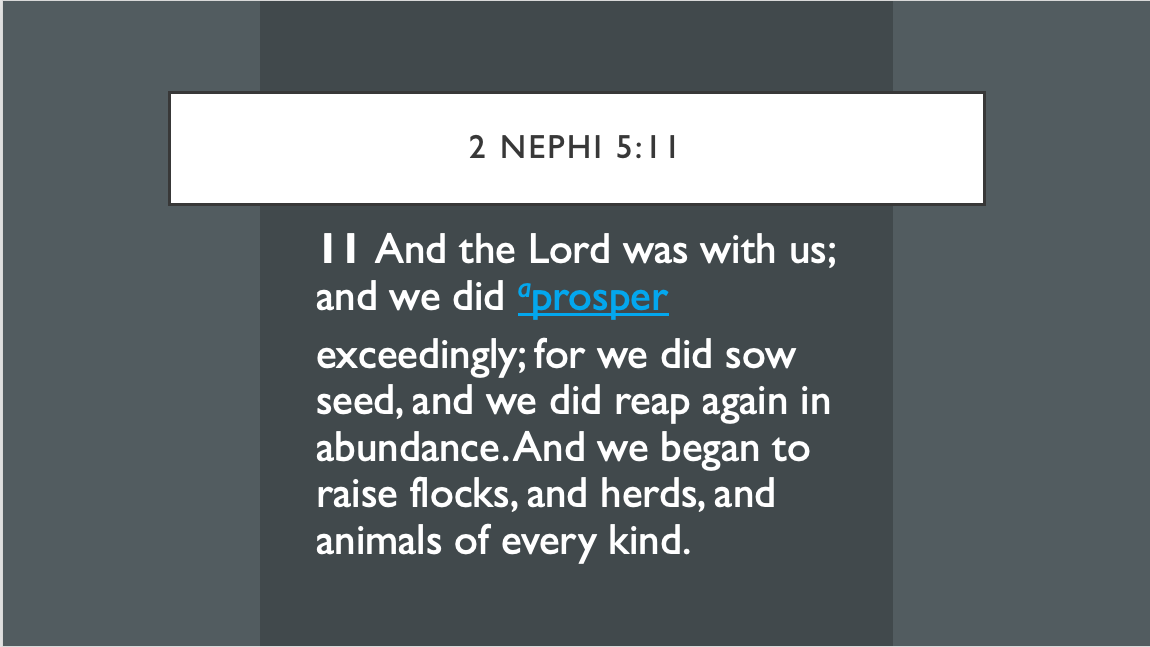
In 2 Nephi 31:15-20, we study that "He that endureth to the end, the same shall be saved." This made me think about 2 Nephi 5:11, that the blessings that come, come with work. That we reap the fruit of the seed that we sow. I added that on the right in the slide below to be viewed alongside President Uchtdorf's insightful words in 2007: 


In 2 Nephi 32:1-6, we learn about how the Holy Ghost instructs us. Nephi understood this well, and chastised his older brother in 1 Nephi 15:8-11 for not understanding this. Again, this goes back to the previous slide, where we discuss that the blessings require effort.


Jacob 1-4

I've skipped over a number of slides that just don't make sense without discussion. Moving on to Jacob 1-4, the next lesson, Jacob talks about how we can "Be Reconciled to God through the atonement of Christ."

I love this image of King Benjamin speaking from a tower so that more people could hear him. He is one of my many scripture heroes, as he was "truly good without guile." We study in the Come Follow Me for Individuals and Families manual about our own worthiness in the Lord's eyes to magnify our callings, and we see how righteous leaders like Jacob did this for his people. Jacob was so faithful. He grew up in the wilderness, wandering for the first part of his life, and listening to his older brothers - not just Nephi, but Laman and Lemuel undoubtedly had opinions and shared them in his presence. However, he was unfaltering in choosing the Lord.


Thinking about Jacob, and of course, the Savior, and how all of these great people magnified their callings while here on earth, what did we learn from them? What do we learn from our leaders today, in all their "humanness"?


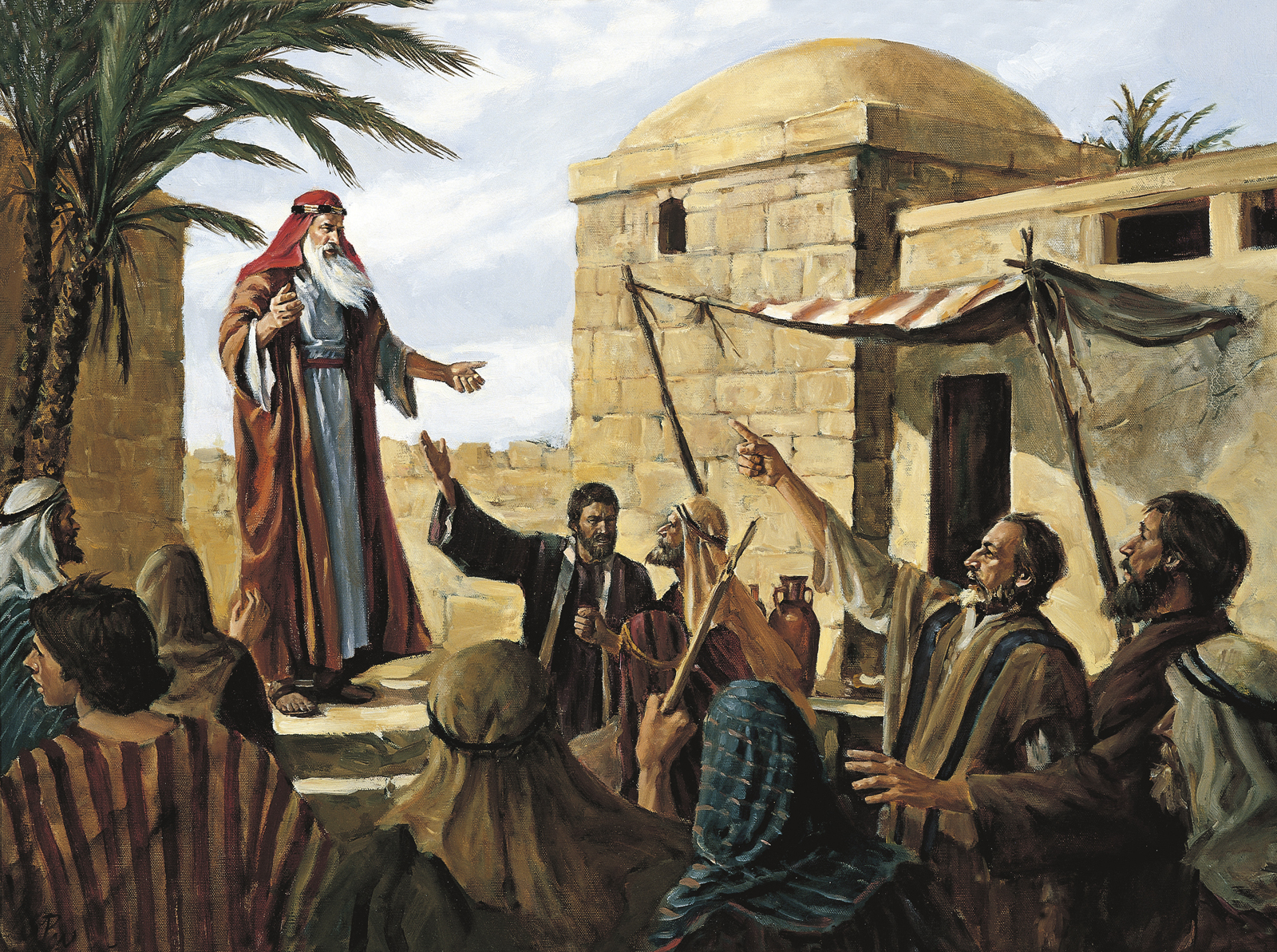
Images: King Benjamin | Lehi | Jesus | Enos


My favorite way that I have seen leaders magnify their callings is in small and simple things - remembering the names of all of their flock. I remember moving into this area and meeting a brother in the ward that I didn't know even know knew my name, and he asked how my husband and I were doing, by name. Later, when he was called to be the bishop, I already felt he was someone that cared about others individually.

I love President Henry B. Eyring's talk, "Rise to Your Call," that he gave in October 2002. He says, "Your call has eternal consequences for others and for you. In the world to come, thousands may call your name blessed, even more than the people you serve here. They will be the ancestors and the descendants of those who chose eternal life because of something you said or did, or even what you were."


In Jacob 2:12-21, Jacob talks about being careful of pride. 

In verse 13 he warns, "you have obtained many riches; and because some of you have obtained more abundantly than that of your brethern ye are lifted up in the pride of your heart ... and persecute your brethern because ye suppose ye are better than they." He continues to verse 18-19, "But before ye seek for riches, seek ye for the kingdom of God. And after ye have obtained a hope of Christ ye shall obtain riches, if ye seek them; and ye will seek them for the intent to do good ..."

The Sunday School manual references an excellent talk from Elder L. Tom Perry:


I also thought this set of scriptures about "looking beyond the mark," would lead to valuable discussion:


I highlighted four points from Elder Cook's talk, and I think this slide alone could be used for an entire one-hour discussion, or even just one of the four blocks that I created:

(“Looking beyond the Mark,” Ensign or Liahona, Mar. 2003, 42–44).


While I'm disappointed that I didn't get to have a discussion with the class and hear all of their amazing and spirit-led insights as they read the scriptures, pondered the lesson, and were inspired in class, I'm grateful to have read the words of Nephi and Jacob in these scriptures, and been blessed by their insights. I have more studying to do on Sunday around these scriptures and am excited to "feast upon the words of Christ" further.

Sunday, February 16, 2020

2 Nephi 1-10: Mercy, Obedience, and the Atonement

I taught adult Sunday School today. This is a portion of the slides I created for class - not all of the slides were used in class, and not all of the slides that were used in class are in this post, either, but these are the ones that I felt translated the best without as much discussion. You can click on any of the images to see a bigger version of them. I also re-typed some of the quotes directly above or below some of these slide images.

This first slide shows who was speaking in each of the first ten chapters of Nephi and to whom they were speaking. It's helpful to understand that context to understand where Lehi or another individual focused their conversation, same as it is in the New Testament with understanding the difference audiences they were speaking to, especially Paul, as he traveled throughout the region and talked to folks with different religious backgrounds. It's also important to remember that they had a precious amount of space on these metal plates, and Jacob felt it was important to use that space to quote Isaiah, which he goes on to do past chapter 10, but this post only covers 2 Nephi 1-10.


These slides show what they were talking about in each chapter:


Some of the themes that really jumped out for me were:
  • The Lord is merciful.
  • We will be blessed IF we keep the commandments.
  • Overcoming afflictions - and sometimes that means fleeing them.
  • Happiness and prosperity means working at something.
  • We should not fear man more than God.
  • Parallels to the teachings and experiences of Christ, Paul, Peter, and other leaders in the New Testament.
  • The atonement.
Examples:


Here's some background I gave on where Lehi traveled and what that land looked like:

There are a number of maps here: 

from a 1976 trip to discover the path that Lehi's family took, traveled and researched by Lynn M. and Hope A. Hilton (go to the link to see the full pictures):


From “Was Lehi Here?” by David A. Edwards – January 2008
Be sure to read the above link for full details as these pictures just give a high level view.
There are also additional photographs at that above link.


Some of the scriptures that we talked about:


There was an excellent comment about how clearly these scriptures lay out the opposites, that even a child can quickly grasp that we can't understand happiness without sorrow, that there is opposition in all things. (There were many excellent comments, but since I was teaching I unfortunately did not have the opportunity to jot them all down.)


I'm re-typing this since the font is so small below. This is from "Our Campfire of Faith" from Elder Gerrit W. Gong in October 2018 conference:

"When we have felt, or feel, uncertain, alone, frustrated, angry, let down, disappointed, or estranged from God and His restored Church, it may take an extra measure of effort and faith to enter again on His covenant path. But it is worth it! Please come, or come again, unto the Lord Jesus Christ! God’s love is stronger than the cords of death—temporal or spiritual.10 Our Savior’s Atonement is infinite and eternal. Each of us strays and falls short. We may, for a time, lose our way. God lovingly assures us, no matter where we are or what we have done, there is no point of no return. He waits ready to embrace us."


In Nephi, we saw the Lord repeatedly giving his people guidance when they were obedient. In some cases, when the burdens became too great, and after multiple chances, the Lord directed them to flee. I thought this was interesting because I've experienced this with making the decision to leave a job, after many attempts to try to resolve a bad situation. The key here is not being a quitter, but knowing when to try to live through the afflication and when to flee. 


Sources for images:
Pioneer Handcarts:
Moses parts the red sea:
Lehi and his people:
The brother of Jared:


In Nephi's case, there came a point when the Lord told him to flee. For example, see 2 Nephi 5:4-5:


I found and read this wonderful talk in the course for preparing this lesson:  "Our Strengths Can Become Our Downfall," by Elder Dallin H. Oaks given in October 1994 at a Brigham Young University Fireside.

He gives a number of specific examples of how if we are not comfortable, something that could be a strength in our life could become a chink in our armor against the adversary. 

He says:

"How, then, do we prevent our strengths from becoming our downfall? The quality we must cultivate is humility. Humility is the great protector. Humility is the antidote against pride. Humility is the catalyst for all learning, especially spiritual things. Through the prophet Moroni, the Lord gave us this great insight into the role of humility: 'I give unto men weakness that they may be humble; and my grace is sufficient for all men that humble themselves before me; for if they humble themselves before me, and have faith in me, then will I make weak things become strong unto them.'" 

I loved this entire talk, and because it was given at a BYU address, it didn't reach the greater audience at General Conference, so I want to encourage everyone to read "Our Strengths Can Become Our Downfall!"


Some of these slides are not saving over well so to re-quote from the slide above, from the talk "Taking Upon Ourselves the Name of Jesus Christ,":

"Finally, I believe that to take upon ourselves His name, we must trust Him. At a meeting I attended one Sunday, a young woman asked something like the following: “My boyfriend and I recently broke up, and he chose to leave the Church. He tells me he has never been happier. How can this be?”
The Savior answered this question when He said to the Nephites, “But if [your life is] not built upon my gospel, and is built upon the works of men, or upon the works of the devil, verily I say unto you [you will] have joy in [your] works for a season, and by and by the end cometh.”22 There simply is no enduring joy outside the gospel of Jesus Christ."


I created this timeline because the powerful thing about what Jacob shares here is that every moment shows the Lord's mercy. 


The Lord showed mercy in:

1. Sending prophets to warn Jerusalem to repent.
2. Warning Lehi that since nobody was repenting, they needed to go into the wilderness.
3. Guiding Lehi's family into the wilderness.
4. Sending the Savior to give the people that rejected the prophets another chance.


We are blessed because we learn from our trials and afflictions, and because for whatever else we cannot overcome, the Lord blesses with our obedience through the plan of atonement. Says Elder Jeffrey R. Holland, in "Where Justice, Love, and Mercy Meet:"

"What a plight! The entire human race in free fall—every man, woman, and child in it physically tumbling toward permanent death, spiritually plunging toward eternal anguish. Is that what life was meant to be? ...
"The answer to those questions is an unequivocal and eternal no! With prophets ancient and modern, I testify that 'all things have been done in the wisdom of him who knoweth all things.'4 Thus, from the moment those first parents stepped out of the Garden of Eden, the God and Father of us all, anticipating Adam and Eve’s decision, dispatched the very angels of heaven to declare to them—and down through time to us—that this entire sequence was designed for our eternal happiness."


2 Nephi 9


50 Come, my brethren, every one that thirsteth, come ye to the waters; and he that hath no money, come buy and eat; yea, come buy wine and milk without money and without price.
51 Wherefore, do not spend money for that which is of no worth, nor your labor for that which cannot satisfy. Hearken diligently unto me, and remember the words which I have spoken; and come unto the Holy One of Israel, and feast upon that which perisheth not, neither can be corrupted, and let your soul delight in fatness.