Showing posts with label Alma. Show all posts

Sunday, August 16, 2020

Preserved by His Marvelous Power - Come Follow Me - Alma 53-63

This week's Come Follow Me study covered Alma 53-63. I had been looking forward to reaching these chapters as it contains one of the most beloved stories of the Book of Mormon, Helaman leading his army of 2,000 stripling warriors because their parents had made a covenant that they would never pick up their weapons of war and shed bled again. This is not the only incredible story in this section of scripture so a quick recap:

  • Pahoran, who was a good and righteous chief judge, has just replaced his father. King-men used this opportunity to try to overthrow the judges and put a king in place. King-men were high born and were basically looking out for themselves. Freeman opposed them.
  • Moroni had to waste precious resources defeating the King-men, who were happy to let the Lamanites ravish their lands since the couldn't put one of their own in place as king. In causing this strife, the king-men weakened the armies that had to direct their energies elsewhere, and the Lamanites were able to steal away many of their fortified cities
  • 2000 stripling warriors took the place of their fathers to help in the war against the Lamanites, who want to steal their land. They did this to protect the people who had taken them in and protected them. They asked Helaman to lead their army.
  • The Nephites had many successes with great leaders like Moroni, Helaman, Teancum, and Lehi at the head of their armies. They employed many clever methods that the Lamanites later tried to employ unsuccessfully. One of them was using the Stripling Warriors to lure the Lamanites out of their stronghold. Another was getting them drunk. 
  • Pahoran and Moroni exchange epistles in which Moroni learns about the king-men uprising and sends armies to help Pahoran.

A Love for their Brethern
This time as I read these verses, what struck me in Alma 53 was that the Ammonites, or the people that had made the covenant to never shed bled again, (also known as former Lamanites, or the "Anti-Nephi-Lehies") were ready to break their oath because they were watching the very people that had saved them from the Lamanites and protected them, now being assaulted by those Lamanites. The Nephites were now in "the most dangerous circumstances" (Alma 53:9) and the Ammonites knew the would have "fallen into the hands of their brethern had it not been for the pity and the exceeding love which Ammon and his brethern had had for them" (Alma 53:11).

They did not want to break their oath yet they were "moved with compassion" toward their brothers that had protected them. This is when Helaman convinced them not to risk losing their souls by breaking their oath. Helaman knew the dangers of the Lamanites but his love of God's children and his love of God was so great that he knew they should not break their oath, that there was another when. When the 2,000 sons that had had grown up and were not under the oath asking Helaman to lead them, they agreed. In each case, the Ammonites, the sons of the Ammonites, and Helaman were motived by a love for their brethern and a love of God.

While the parents of these stripling warriors had much faith, remember that the wars between the Nephites and Lamanites, and also a dissenting group within the Nephites, the king-men and the freeman, had resulted in many deaths and many losses. I imagine that the fathers and mothers of these stripling warriors were proud of their sons but also they must have been a little scared. After all, being righteous did not guarantee being protected from death. In Alma 60:13, Moroni, chief captain over the army writes to Paharon, chief governor of the land, and states, 

"For the Lord suffereth the righteous to be slain that his justice and judgement  may come upon the wicked; therefore ye need not suppose that the righteous are lost because they are slain; but behold, they do not enter into the rest of Lord their God."

Their Parents Taught them Faith
The stripling warriors had never fought before but there were two particularly large battles against the Lamanites that emerged with the Stripling Warriors, and each time, no lives were lost among these 2,000. 

I love the respect and love from Helaman to these warriors in which he called them his sons, when he wrote to Moroni about them. He later talks about their obedience and faith and how it led to success in battle: 

"Yea, and they did obey and observe to perform every word of command with exactness; yea, and even according to their faith it was done unto them; and I did remember the words which they said unto me that their mothers had taught them." (Alma 57:21).

What are these words?

Helaman explained, 

"... they did not fear death; and they did think more upon the liberty of their fathers than they did upon their lives; yea, they had been taught by their mothers, that if they did not doubt, God would deliver them. And they rehearsed unto me the words of their mothers, saying: We do not doubt our mothers knew it." (Alma 56:47-48).

Liberty, not Bloodshed
The scriptures were emphatic about the motives between the Lamanites and the Nephites. The Lamanites were focused on vengeance against perceived wrongs taught to them by Laman and Lemuel. They were led by a king (Amalickiah) who had earned that crown by deceit and by slowly poisoning the previous king. The Nephites had one goal, their title of Liberty. 

When Helaman writes to Moroni to recount how they had successfully defended their cities and taken back the land in their region, he restates the same things that Moroni wrote in the Title of Liberty, 

"... the Lord our God did visit us with assurances that he would deliver us; yea, insomuch that he did speak peace to our souls, and did grant unto us great faith, and did cause us that we should hope for our deliverance in him. And we did take courage with our small force which we had received, and were fixed with a determination to conquer our enemies, and to maintain our lands, and our possessions, and our wives, and our children, and the cause of our liberty" (Alma 58:11-12).

While the Lamanites were taking Nephite woman and children captive, and slaying Nephite men, the Nephites were taking men captive in hopes of future trades. In fact, in Alma 62:27, they let Lamanite prisoners to make a covenant to join the people of Ammon as free people. They were interested in capture and destruction. Moroni found several opportunities to take back strongholds without killing. In one case, he tricked the Lamanites into becoming drunk (by sending Laman, an old former servant of the former Lamanite king) who lied and said he had escaped with wine. Moroni used that opportunity to free his people, not to destroy:

"But behold, this was not the desire of Moroni; he did not delight in murder or bloodshed but he delighted in the saving of his people from destruction; and for this cause he might not bring upon him injustice, he would not fall upon the Lamanites and destroy them in their drunkness." (Alma 55:19).

Moroni explained himself simply to Pahoran. 

"I seek not for power, but to pull it down. I seek not for honor of the world, but for the glory of my God, and the freedom and welfare of my country." (Alma 60:36).


Captain Moroni Raises the Title of Liberty

They Grew Weak when they Forgot, and Found Happiness when they Remembered
I talked in my previous post about the amazing amount of preparation that Moroni put into protecting his people. It's frustrating that he built up and fortified every city so well, only to have many of them stolen away by the Lamanites. Of course, we learn in these chapters that Moroni takes many of the cities back, and then Helaman does the same with all of the cities in his area. However, how could this happen?

It takes me back to what I discussed in the previous post, that we must prepare always and watch always. There were three contentions mentioned during this set of scriptures, one that was not described in detail, one with the king-men trying to repeatedly overthrow the chief judge and put one of their own in place as king, and one with the people of Morianton trying to claim a part of the land of Lehi, unrighteously. Moroni writes in frustration to Pahoran that "had it not been for the war which broke among us" (specifically referencing the king-men), "had they been true to the cause of our freedom, and united with us, and gone forth against our enemies ... if we had gone forth against them in the strength of the Lord, we should have dispersed our enemies."

By Alma 62 the king-men had been quelled, and the people of Nephi began to prosper again, in fact, it says they grew "exceedingly rich." The key here, though, was that when they put their title of liberty first, when they looked to God, they were happy.

"But notwithstanding their riches, or their strength, or their prosperity, they were not lifted up in the pride of their eyes; neither were they slow to remember the Lord their God; but they did humble themselves exceedingly before him. 

"Yea, they did remember how great things the Lord had done for them, that he had delivered them from death, and from bonds, and from prisons, and from all manner of afflictions, and he had delivered them out of the hands of their enemies. 

 "And they did pray unto the Lord their God continually, insomuch that the Lord did bless them, according to his word, so that they did wax strong and prosper in the land." (Alma 62:49-51)

I leave my thoughts by rewinding from the 39th year of the reign of the judges from which the book of Alma ends, back to Alma 50 when "there never was a happier time among the people of Nephi, since the days of Nehpi, than in the days of Moroni, yea, even at this time, in the twenty and first year of the reignt of the judges." (Alma 50:23).

May we look at these two times of happiness and prosperity and remember that during these times, the people were looking to God, they were not caught up in pride, and they were constantly preparing and fortifying themselves both physically and spiritually. 

Sunday, August 2, 2020

Teachings of a father to a son: the great blessings of the resurrection

This week's "Come Follow Me" study covered Alma 39-42. Last week, I wrote a little about Alma's guidance to his sons Helaman and Shiblon. This week, these four chapters are directed to his youngest son, Corianton. The interesting thing is that Alma spends so much more time talking to Corianton but it's because Corianton has made some bad choices and Alma is concerned for his welfare and for the example that Corianton is setting for others. In addition, he knew Corinaton had questions and needed some answers, and he was willing and able to answer, therefore we get to learn more about the mysteries of the resurrection.


The sin Corianton committed was visiting with the harlot Isabel. (Alma 39:3-4). Alma says to Corianton in Alma 39:11, "... Behold, O my son, how great iniquity ye brought upon the Zoramites; for when they saw your conduct they would not believe in my words." 

How many times have you personally, or seen a parent scold an eldest child for doing something that you knew all the younger children would immediately follow and do? Corianton was the youngest son but the eyes of those around him were watching him. Alma knew these consequences personally because from the day of his repentance, he and the sons of Mosiah sought undo the damage they had done preaching against God in their younger years.

I take what I know about the resurrection for granted because I've been taught from and learning from these scriptures for my entire life. However, I tried to read this from the perspective from one who is learning from the first time. Through those eyes, Alma 41:5 really stood out to me, "For as he has desired to do evil all the day long even so shall ye have his reward of evil when the night cometh." In other words, when we are resurrected, we bring with us the spiritual baggage that we wrought. "... the meaning of the word restoration is to bring back again evil for evil, or carnal for carnal, or devilish for devilish - good for that which is good; righteous for that which is righteous; just for that which is just; merciful for that which is merciful." (Alma 41:13). Or, "what which ye do send out shall return unto you again, and be restored." (Alma 41:15). 


There are many martyrs in the scriptures, those that have died while holding firmly to their belief in Heavenly Father and the commandments to repent shared by the prophets of those times. I am reassured that though their lives ended in a way that caused great mourning to those who loved them, they will be restored and rewarded for their faith. I am also reassured when I read Alma 42:23, "But God ceaseth not to be God, and mercy claimeth the penitent," that our Father in Heaven loves us SO MUCH, and that he sends prophets, and that these ancient records have been preserved so that we can remember and we can return to him. If our repentance is sincere, our God is merciful and full of love. Corianton went on to repent and to heed Alma's guidance, to "declare these tidings unto this people, to prepare their minds ... that they may prepare the minds of their children to hear the word at the time of his coming." (Alma 39:16). 

Sunday, July 12, 2020

Alma 30-31: The Word of God and Leading with Our Hearts

When we reach Alma 30, we're in the 16th year of the reign of the judges. That means 16 years since King Mosiah passed away at the age of 82, and 16 years since he made sure to establish a system of judges to protect the people from unrighteous rulers, since he knew that his four righteous sons had chosen to travel to preach the gospel of God rather than become the next king. It astounds me how much happens over those sixteen years.

Many tried to take over as unrighteous rulers, so King Mosiah was very wise, and led by the Lord. Nehor introduced priestcraft, Amlici led people away that became the hard-hearted Amlicites, and  thousands upon thousands died by the sword, both the righteous who became martyrs, and those who chose to follow the devil. Yet, during all those times of darkness and trial, we can see the hand of God in all things. There were prophets and men of God to stand as his witnessses and to give people a choice, and the faith of the righteous was a powerful thing, as people were given the choice, in Zarahemla, in Alma 30:8, to "choose ye this day, whom ye will serve." The Lord was constantly giving people the opportunity to hear the Word of God and to choose to serve him, through Alma, Ammon, Aaron, Omner, Himni, the converted Zeezrom, the converted Amulek, the converted hand-maiden to King Lamoni's wife, the righteous judges that upheld peace in the land.


In Alma 30, Korihor made several attempts to lead people away. Korihor's attempts to cast doubt for the followers of God are powerful because they are some of the same prevalent messages we hear today. He asks, "How do ye know of their surety?" in Alma 30:15. I love Alma's response in Alma 30: 44, "... Thou has had signs enough; will ye tempt your God? will ye say, Show unto me a sign, when ye have the testimony of all these thy brethern, and also all the holy prophets? The scriptures are laid before thee, yea, and all things denote there is a God; ye, even the earth, and all things that are upon the face of it, yea, and its motion, yea, and also all the planets which move in their regular form do witness that there is a Supreme Creator."

With these words, Korihor first went to Zarahemla where he was successful in creating some doubt. Then, he went to Jershon, where these men and women had refused to lift up arms to protect themselves and many had died as martyrs. Their faith had been recently tested and was strong. In fact, it says in Alma 27:27 that they were "distinguished for their zeal towards God, and also toward men; for they were perfectly honest and upright in all things; and they were firm in the faith of Christ, even unto the end."  The people of Ammon, or the Anti-Lehi-Nephites, or the former Lamanites, could not be deceived by Korihor.

Korihor also tried to deliver his anti-Christ message to the people of Gideon but Alma had visited them in Alma 6 and preached to them to remind them to remember their God. He said to them in Alma 7:17, "... Behold, I say unto you, yea, I know that ye believe them; and the way that I know that ye believe them is by the manifestation of the spirit which is in me. And now because your faith is strong concerning that, yea, concerning the things which I have spoken, great is my joy." He saw they were receptive to the Spirit and gave them more tools to stay strong, to be humble and not tempted, and that the Lord would bless them.

It was some of the original Nephites in the land of Zarahemla that fell victim to Korihor's words. I want to point this out because some people perceive that our labels and titles, or our past or our heritage, denote who is righteous or good. Remember, in 1 Samuel 16:7 in the Bible it says, "Man looketh on the outward appearance, but the Lord looketh on the heart." The people of Ammon, also known as the Anti-Lehi-Nephites had been Lamanites and probably most of them had sinned against God but once they converted to God, they changed, and it says in Alma 27:30, "they were a zealous and beloved people, a highly favored people of the Lord." That is, because as we know, the Lord looked at their hearts and found it pleasing. What their ancestors had done before them, or their label as Lamanites, didn't rule what they did with their hearts.

When in doubt about what is good and righteous and what is disguised as good, Alma's advice in Alma 7:23-25 comes to mind:


In a message from Elder Dieter F. Uchtdorf of the Quorum of the Twelve Apostles, on June 9, 2020, he says, "Somehow, these challenging times helped us to be more open about the feelings of our soul. We realized even more clearly how special it is not to hide or mask the feelings of our hearts from those we love most. ... I can sense the sorrow and burden so many of you have to live with. And I can also feel your joy and enthusiasm as you focus on the many good things you can do in life. It is amazing to see how you help and uplift each other by word and deed." The Lord looks upon our hearts, and how our words and deeds suit the desires of our hearts - to serve God or Mammon.
(See Matthew 6:24).

In Alma 31:21, Alma was dismayed to see that the Zoramites in the land of Antionum had built a tower called Rameumptom, where they repeated the same memorized saying to God one at a time (that they were the elected, and there was no Christ), then "returned to their homes, never speaking of their God again until they had assembled themselves together again to the holy stand, to offer up thanks after their manner." (Alma 31:21-23). Alma felt, "exceedingly sorrowful," begging the Lord and saying "their souls are precious, and many of them are our brethern." Again, the hand of God in all things - he blessed Alma for this great faith and sincerity with an overwhelming feeling of the Spirit of God and "gave them strength, that they should suffer no manner of afflictions, save it were swallowed up in the joy of Christ. Now this was according to the prayer of Alma; and this because he prayed in faith." (Alma 31:38). We'll see in Alma 32 when I blog next, on how the Lord sought to bless all of his children through faithful leaders like Alma.

I'm so grateful for the Book of Mormon and for the Bible and how the examples of the people that were willing to repent and change, and the leaders who loved so deeply fought, and sacrificed and worked alongside their people (Alma 30:33-35), helps strengthen and guide me.


Wednesday, July 8, 2020

The Book of Alma 23-29: In His Strength, I Can Do All Things

Alma 23-29 contains some of the most beautiful individual verses amid a lot of war and death.

A quick summary of some key moments leading up to these chapters
If you'll recall from Alma 20, while Ammon was having some success in converting people to God in Ishmael, his brothers, Aaron, Omner, and Himni were having a rough time in jail in Middoni. It says in Alma 20:29 that they "suffered hunger, thirst, and all kinds of afflictions; nevertheless they were patient in their sufferings."

These men could have become great kings of their land, and in fact, turned down the role, one by one. They were so determined to turn people to God the way they had been turned. Yet, they were reviled by a very hard-hearted people that might have reminded them of themselves many years ago.  We see this theme replay over and over throughout history, not just the history of the Book of Mormon and the Bible but in the history of the world. We have the same basic vices, and we fall on them again and again, which is why the Lord constantly reminds us through prophets to watch ourselves, and focus on Him.

Ammon, fortunately, had King Lamoni on his side, and after the benevolent way that Ammon treated King Lamoni's father, he also had the King of all Lamanites protecting him, and enabling him to get his brothers out of jail, and allowing them to preach under his protection.

Throughout it all, the brothers did not give up courage. Aaron reveals in Alma 26:27, "Now when our hearts were depressed, and we were about to turn back, behold, the Lord comforted us, and said: Go amongst they brethern, the Lamanites, and bear with patience thine afflictions, and I will give unto you success."

Their faith resulted in thousands of converts to God
In Alma 23, after escaping prison and rejoining with Ammon, the four brothers were able to preach freely and as a result, the Lamanites in seven different lands were converted and renamed themselves Anti-Nephi-Lehies. This is thousands of people that were so committed to their conversion, and so grieved by the sin of their past and their ancestry, that they covenanted in Alma 24 to put away their weapons forever, even though these weapons were also their source of protection.

Ammon, Aaron, Omner, and Himni were patient and they trusted in the Lord. Between the four of them, they were responsible for the conversion of THOUSANDS of people. Remember, it says in Doctrine and Covenants 18:15, "And if it so be that you should labor all your days in crying repentance unto this people, and bring save it be one soul unto me, how great shall be your joy with him in the kingdom of my Father!" And then it follows in Doctrine and Covenants 18:16, "And now, if your joy will be great with one soul that you have brought unto me into the kingdom of my Father, how great will be your joy if you should bring many souls unto me!"

Aaron truly understood that their afflictions had been great for potentially great reward, as he says in Alma 26:30, "And we have suffered all manner of afflictions, and all this, that perhaps we might be the means of saving some soul; and we supposed that our joy would be full if perhaps we could be the means of saving some."

We see this joy in Alma 26, where Ammon and Aaron use the word "joy" a total of nine times as Aaron talks about why it's not boastful to be grateful that they have been responsible for so many conversions to Christ. Aaron says powerfully in Alma 26:12, "Yea, I know that I am nothing; as to my strength I am weak; therefore I will not boast of myself, but I will boast of my God, for in his strength I can do all things; yea, behold many mighty miracles we have wrought in this land, for which we will praise his name forever."

I love this message of hope that they surely understood as they fought the tide against the hard hearted, in Alma 26:6, "Yea, they shall not be beaten down by the storm at the last day; yea, neither shall they be harrowed up by the whirlwinds; but when the storm cometh they shall be gathered together in their place, that the storm cannot penetrate to them; yea, neither shall they be driven with fierce winds whithersoever the enemy listeth to carry them."

Martyrs softened hearts
The interesting thing about the last verse that I quoted, which gives me so much hope and peace, is that it comes after we learn in Alma 24:22 that the Lamanites that would not listen took up arms against their brothers. Since the Anti-Nephi-Lehites refused to pick up their weapons, they became1005 martyrs. It would seem that the storm DID penetrate them, yet, we learn that despite this sorrowful circumstance, these men and women "are blessed, for they have gone to dwell with their God"(Alma 24:22). They may not have intended this, but as they died, they brought more souls to Christ. How great was their joy as they returned to their Father!

We also see that two things happened:
1. The wicked ones were mad that they had killed their fellow brothers, and instead of feeling regretful for their terrible mistake, they actually blamed the Nephites and crossed into Ammonihah to kill more people! (Alma 25:1-4).
2. The ones that still had some heart left realized they had made a terrible mistake, and sought out those that had converted in the lands of Ishmael and Nephi, and joined them. They also promised to bury their weapons of war and, "they did walk in the ways of the Lord, and did observe to keep his commandments and his statues." (Alma 25: 14).

Return to Zarahemla
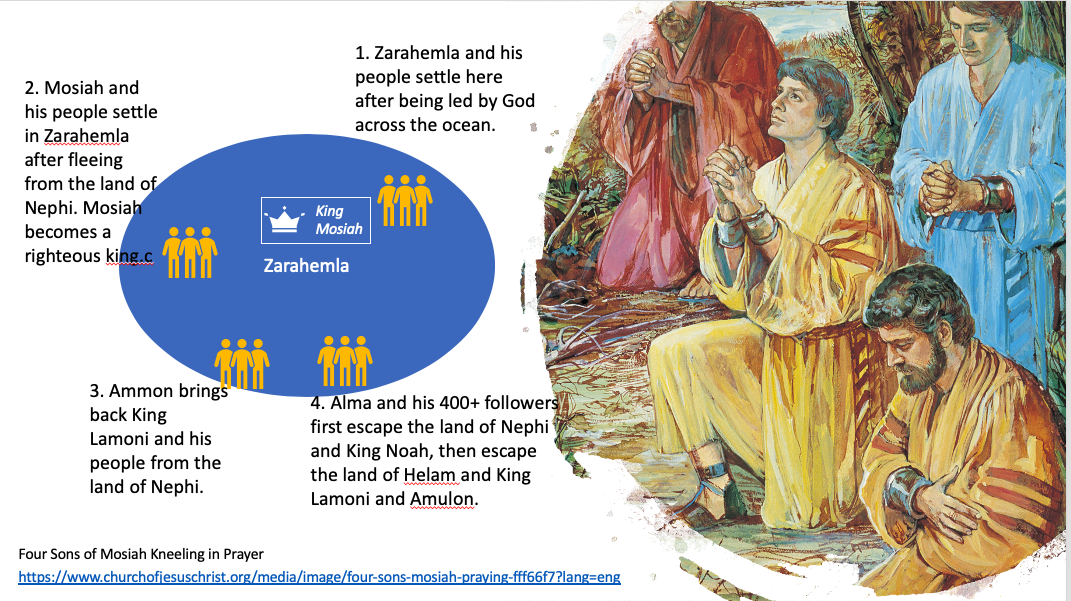
I have observed this several times in the past, but Zarahemla was once again a gathering place in Alma 27. The land had been ruled peacefully and inhabited by people of God, and the people of God were guided to return there again and again. This diagram I put together was at the end of a video talk I shared a couple of months ago to drive that point home. Click to view larger image:


The Lamanites that were Amalekites and Ammunolites were so wicked and so evil that their hard hearts could not be pierced, and they were a murderous people. Eventually, after talking to King Anti-Nephi-Lehi, Ammon consulted with the Lord and was directed to go to Zarahemla, where they were given the land of Jershon (Alma 27:22) and renamed themselves from Anti-Nephi-Lehi to "the people of Ammon" from that time forward.

I love that their distinction was in Alma 27:27, "... they were also distinguied for their seal towards God, and also towards men; for they were perfectly honest and upright in all things; and they were firm in the faith of Christ, even unto the end."

Peace in the Lord
I have talked about this theme a lot, but I think we are in a time of great distress and we need the Lord more than ever. In Alma 28, we are reminded that there were many wars throughout the land, the wicked slaughtering the righteous. It wasn't that just because they repented, there were no deaths. Yet, in says in Alma 28:12, "While many thousands of others truly mourn for the loss of their kindred, yet they rejoice and exult in the hope, and even know, according to the promise of the Lord, that they are raised to dwell at the right hand of God, in a state of neverending happiness."

I want to end with these powerful scriptures in Alma 29:1-2:

"O that I were an angle, and could have the wish of mine heart, that I might go forth and speak with the trump of God, with a voice to shake the earth, and cry repentance unto every people! Yea, I would declare unto every soul, as with the voice of thunder, repentance and the plan of redemption, that they should repent and come unto our God, that there might not be more sorrow up all the face of the earth."


Sunday, June 21, 2020

Alma 13-16 - Alma, Amulek, Zeezrom, and the city of Ammonihah

When we left off from my previous post, Alma had become discouraged by the hard-heartedness of the people of Ammonihah, and had been about to depart for the city of Aaron to preach there instead, when the Lord through an angel told him to go back and try again, and where Amulek, having seen an angel, was prepared to feed Alma.

Protect Ourselves by Listening and Being Humble
So many times in ancient history, we've read about the Lord sending prophets to go back to a city that wouldn't listen, and to try again. Abinadi did this for King Noah's people, and Lehi did this for the wicked city of Jersusalem. Each time that the people did not listen, their cities were destroyed, and the people either died or were taken into bondage. The same thing happens with Ammonihah, that boasts in Alma 9:4-5 that they cannot be destroyed in a day. In Alma 16:3, 9, 10, we read "... and the people of Ammonihah were destroyed; yea, every living soul of the Ammonihahites was destroyed, and also their great city, which they said God could not destroy." The Lord loves his children and it was reaffirmed to me again that he sent prophets back again and again because he truly wanted to give the people an opportunity to listen and repent, and in some cases, some heard and repented.

It is a great reminder not to be lifted up in the pride of our hearts, never to forget that our gifts come from the Lord, and that they should be used to lift others up, not for our own pride.

This scripture from earlier came to mind as I was reading this section of scriptures: Mosiah 4:30: "But this much I can tell you, that if ye do not watch yourselves, and your thoughts, and your words, and your deeds, and observe the commandments of God, and continue in the faith of what ye have heard concerning the coming of Our Lord, even unto the end of your lives, ye must perish. And now, O man, remember, and perish not." 

Alma reminds us in Alma 13:28-29, "But that ye would humble yourselves before the Lord, and call on his holy name, and watch and pray continually, that ye may not be tempted above that which ye can bear, and thus be led by the Holy Spirit, becoming humble, meek, submissive, patient, full of love and all long-suffering; Having faith on the Lord; having a hope that ye shall receive eternal life; having the love of God always in your hearts, that ye may be lifted up at the last day and enter into his rest."

In Alma 13, alma reminds of us Melchizedek, whose people had forgotten to be humble and forgot their God. However, Melchizedek exercised much faith, and preached repentance to his people. They listened, and as a result, it says in Alma 13:18, "... Melchizedek did establish peace in the land in his days."

The Opportunity for Repentance
The sad thing about these cities being lost and destroyed is that it was entirely preventable if people would stop hardening their hearts. I thought it was interesting and maybe a little ironic that Alma had to content with the savvy lawyer Zeezrom because Zeezrom might not have realized that when Alma was younger, he was just like Zeezrom, preaching things that were opposite to the word of God (see Mosiah 27). 

Remember, Zeezrom was one of the very successful lawyers at the time, and the reason he sought to destroy Alma and Amulek was because if people and were good, then they didn't need to be brought before the judges, which then took away the livelihood of the lawyers. They wanted people to make mistakes because it was very profitable for them. So, it is interesting that as Zeezrom sought to destroy Alma and Amulek with words, he suddenly realized that he was truly talking to men of God, and that he had made a terrible mistake preaching against them. In Alma 14, Zeezrom tried to right his wrongs but the people that had previously listened to him not cast him out too. Alma and Amulek were then taken to jail, and many of God's followers were burned in a fire. 

Zeezrom wouldn't know that the Lord was with them and protected them, and killed the evil lawyers and judge by having the prison walls come down upon them, until the two arrived in Sidon and found the people that had fled. Sounds familiar? Alma was following some of the patterns of his father, taking people out of the city with him that were believers of God, and in Alma 15:12, it says, "Alma baptized Zeezrom unto the Lord; and he began from that time forth to preach unto the people." Just like Alma's father who used to be one of King Noah's evil high priests, just like Alma who used to preach against God, Zeezrom learned that he had been following the wrong path, repented, and devoted his life to preaching the word of God.

The Power of Sacrifice
Amulek, Alma, and Zeezrom all made great sacrifices to preach the word of God. Amulek was a wealthy man with much respect and friends. It says in Alma 15:16 that he lost the support and respect of his father, his friends, and he had to give up his worldly possessions as he left them behind in Ammonihah. 

I thought it was beautiful though that Amulek met Alma when he first fed him after Alma had fasted many days, and after their harrowing experience in Ammoniah, that Alma took Amulek back to Zarahemla, and in Alma 15:18, it says that he "took him to his own house, and did administer unto him in his tribulations, and strengthened him in the Lord." 

Amulek had to watch a lot of good men and women die for their their beliefs too, and that was hard for him to see, and though we are reminded that "the Lord receiveth them up unto himself in glory" (see Alma 14:11) I don't think that necessarily lifted the sorrow from their hearts. But the Lord was with them and they were blessed as they continued to choose God over their fears and the pride of the world.

We are Equals in the Lord's Eyes
My final thought this week was that we are truly equal in the Lord's eyes. There are unfortunately a lot of voices out there saying otherwise, or trying to demean the voices asking for equality by shrugging it off as not a "real" issue, or using callous labels to demean others or lay unfair blame on the door of an entire race, and pretending injustices aren't happening. The Lord sees all of us, and he sees how we choose to live each moment of our lives. In ancient times he uses angels more frequently, in modern times, he gives us promptings to be each other's angels, to lift each other up, as equals, brothers and sisters and children of a Heavenly Father.

In Alma 16:14 we are reminded, "And as many as would hear their words, unto them they did impart the word of God, without any respect of persons, continually." Alma and Amulek preached to anyone who would listen, as the gospel is for everyone. 

In Alma 16:15 we learn that though the scriptures here talk about Alma and Amulek, "many more" were "chosen for the work." 

And in Alma 16:16, it says, "And there was no inequality among them; the Lord did pour out his Spirit on all the face of the land to prepare the minds of the children of men, or to prepare their hearts to receive the word which should be taught among them at the time of his coming."


Sunday, June 14, 2020

"Jesus Christ Will Come to Redeem His People" - Alma 8-12

As I read Alma 8-12 this week, a much-quoted line that I believe originated from President Thomas S. Monson in his October 2012 talk, "Consider the Blessings," came to mind. He said, "... Heavenly Father is aware of our needs and will help us as we call upon Him for assistance. I believe that no concern of ours is too small or insignificant. The Lord is in the details of our lives." Today I want to share some thoughts about how I have seen that this is true.

The Lord Sends Missionaries to Save His People
This week's theme from the "Come Follow Me" manual is "Jesus Christ Will Come to Redeem His People." Our Heavenly Father has always used servants of God to help teach and serve, and these chapter are no different. In Alma 8, Alma has stepped down from the Chief Judgement seat, which was a place of honor and power, as the judges had replaced the king in the land. He did this because his heart ached for every soul that had not come to God.

By Alma 8:15, Alma was "weighed down with sorrow." While he had been successful in his missionary journeys to Zarahelma, Gideon, and Melek, at this point he was weighed down because he had left Ammonihah, and there, the people were so hard-hearted that they "spit upon him, and caused that he should be cast out of their city." (Alma 8:13.) Alma was crushed by the wickedness of his people. Contrast this to people like Nehor and Amlici in previous chapters, that were seeking fame and fortune. Alma just wanted to save souls.

I had this confirmation that the Lord is in the details of our lives as an angel visited Alma in Alma 8:15 and asked him to "lift up they head and rejoice, for thou has great cause to rejoice; for thou has been faithful in keeping the commandments of God." He then asked Alma to return to Ammoniah to preach repentance.

The Lord Prepares a Way
The Lord also sent an angel to Amulek to prepare him for Alma's return to Ammoniah, letting him know that Alma would need to be fed, and that Amulek and his family would be blessed for it.

This preparing of the way reminded me of the Acts 10 in the Bible, that was written in the years after Jesus died on the cross, and his apostles had gone out to continue teaching his word. This chapter talks about a devout man that feared and prayed to God but did not have the full gospel of Jesus Christ in his life. He was a Gentile. Cornelius was told by an angel to send for Simon Peter in the same way that Amulek was told to wait for Alma. Both were blessed for their faith. In both cases, a prophet of God visited with them because the prophet was also listening to the Lord.

In Alma 9:25 it says, "And now for this cause, that ye may not be destroyed, the Lord has sent his angel to visit many of his people, declaring unto them that they must go forth and cry mightily unto this people, saying: "Repent ye, for the kingdom of heaven is night at hand." I love this reminder that the Lord expects us to live up to the level of light and knowledge we have about the gospel of Christ but that he does not want us to fail. He sends prophets, preachers, scriptures, and more to give us ample reminders lest we forget to be as Alma says in chapter 7:32: humble, submissive and gentle, easy to be entreated, full of patience and long-suffering, temperate in all things, diligent in keeping the commandments of God at all time, always returning thanks unto God, with faith, hope, and charity, always abounding in good works.

Pride Cometh Before the Fall
In Alma 9:4-5, the people of Ammonihah that refuse to listen to Alma brag that a city as great as theirs could not be destroyed. Alma immediately reminds them that Jersualem said the same thing in 1 Nephi 1 when Lehi preached repentance to his people. This theme happened in the scriptures, and is happening in the world, over and over again. When we forget the Lord, become puffed up in pride and greediness, the cities we build, the wealth we've gained, will eventually come crumbling down. Alma reminds them in Alma 9:8, "how have ye forgotten the tradition of your fathers; yea how soon ye have forgotten the commandments of God."

He reminds the people in Alma 9:26, "And not many days hence the Son of God shall come in his glory; and his glory shall be the glory of the Only Begotten of the Father, full of grace, equity, and truth, full of patience, mercy, and long-suffering, quick to hear the cries of his people and to answer their prayers."

We must forget that our blessings and our gifts come from the Lord. If we can remember, we can focus on how to use our brief time here on earth wisely, to be kind, gentle, patience, and to keep the commandments of God.

Choosing Greed Before God
In Alma 10 and 11 the lawyers fight against Alma and Amulek, hoping to make them look bad because if the people repent, and no longer needs lawyers to defend themselves from the judgement seat, then those lawyers lose some of their income. This is reminiscent of Corinthians in the Bible, where in some areas of the land, Aphrodite was worshipped, and metal workers greatly profited from making metal idols. They also fought the word of God because the more people that turned to God, the less people they had to buy their metal works. How neat would it have been if these lawyers and metal workers could have looked for way to re-target their talents and skills?

During this Covid-19 pandemic, and the great mourning of our Black brothers and sisters as they fight for true equality, I have seen people successfully shift their skills rather than fight for greed before God. For instance, in response to the pandemic, a local restaurant that made a great deal of their money by catering to wedding events, and likely had a little more money than some of the other smaller, struggling businesses, paid their employees that now no longer had any work, to go and volunteer at the other businesses that were struggling to get by. To support our Black community, the global tech company where I work has created new education channels and donated $1 million to the EJI that defends human righhts, among other activities. I am citing examples that are close to me but I wanted to share these two examples from groups that don't represent the Church of Jesus Christ of Latter-day but are being Christ-like, the way that Cornelius and Amulek may not have known God well, but sought to be Christ-like, and chose God before Greed.

In Alma 10:4-5, Amulek was a successful man but he stated that despite his successes, he hadn't known God, until he realized that he did. He says in Alma 10:5, "... I mistake, for I have seen much of his mysteries and his marvelous power; yea, even in the preservation of the lives of this people."

Themes from Come Follow Me guide
I want to briefly touch on some of the topics in the Come Follow Me guide and how some of the thoughts above relate.

1. "My efforts to share the gospel may require persistence and patience."
This goes along with what I was reminded that the Lord prepares a way - but he doesn't always prepare the pay we might expect, in the timeline we might expect. I talked about this earlier, when Alma's father, Alma, was leading his people away from evil King Noah. They were in bondage for some time to the Lamanites before they could escape. Persistence and patience is always a theme in life and it's worth it. I compare it to the patience of earning a high school diploma or a college degree, getting ready to run a 5K from not having run before, recovering from an illness and getting your body healthy and strong again.

2. "God's plan is a plan of redemption."
God has commandments in place for us to return to him but he very clearly does not want us to fail. That is why he sends us so many maps, so many guides. We have the Bible, the Book of Mormon, teachings from our prophets and leaders that are recorded on our church website, and in words of the prophets books, among other places. We have prophets, bishops, and weekly sacrament. It is all in place to help us to success in his plan.

3. "If I will not harden my heart, I can receive more of the word of God."
The more we listen, the more we get to learn. I loved what Amulek said about this in Alma 10:4-5, that I referenced above. In Alma 11and 12, Zeezrom, a lawyer, tries to convince the people that Alma and Amulek are wrong. He thinks he can do this because he's a very skilled lawyer. I think it's interesting that Alma used to go about preaching against the word of God. Essentially, he was Zeezrom before an angel of the Lord struck Alma dumb and called on him to repent. Alma knew exactly what he was doing. He let Amulek do the talking and before long, Zeezrom was shaking as he heard the truth.

I affirm that the Lord is in the details of our lives. He sees us, he knows us, and as we willingly place our trust in him, he will help us, though the path may be steep and not so very straight.


Sunday, June 7, 2020

Come Follow Me - Alma 5-7 - "Have Ye Experienced This Mighty Change In Your Hearts?"

Good afternoon. I hope you are having a beautiful Sunday.

I jotted down some thoughts as I read Alma 5-7, and what scriptures stood out to me. Afterward, I read the Come Follow Me guidance for Alma 5-7, and came away with some additional thoughts. I will again focus on my own reactions though, and encourage you to read the manual for those additional opportunities to ponder.

He Knows Us
Alma 5:15-16 reminds us that we are fooling only ourselves when we choose to be dishonest with our fellow man. It says, "do ye imagine to yourselves that ye can lie unto the Lord in that day, and say - Lord, our works have been righteous works upon the face of the earth - and that he will save you?" If we seek the praise of the world outwardly by pretending to be Christlike, but inside we are envying, and scheming, finding way to cheat and lie, then we are doing a disservice not just to the Lord but to ourselves. The Lord knows us and he wants us to benefit from the joy and blessings of following Christ.

The Gospel is for Everyone
Our God is a God of inclusion. There is no limit to how many of us can return to Him. He cries for every soul that is lost and will always look to bring the lost sheep back. I felt that reaffirmation as I read Alma 6:5-6, that "none were deprived of the privilege of assembling themselves together to hear the word of God" and that for those that chose not to listen, those who DID listen were not just asked, but commanded, to "gather themselves together oft, and join in fasting and mighty prayer in behalf of the welfare of the souls of those who knew not God."

The Importance of Teaching
Alma dedicated his life to the Lord, and went so far as to step down from the judgement seat where he was doing much good, in order to preach among the people. As he explains this in Alma 7:1-2, it reminded me of Paul traveling throughout the lands in Corinthians and further, writing to his people and explaining why he couldn't get there sooner. Christ himself came to this earth and tirelessly traveled and taught.

An Eye Toward God
In Alma 7:7, as Alma preached in Gideon, he knew he was talking to good people that were diligently trying to follow the teachings of the church. Yet, he still felt it was important to remind them that with all they would see in the world, there was one thing that was most important. He said, "For behold, I say unto you there be many things to come; and behold, there is one thing which is of more importance than they all - for behold, the time is not far distant that the Redeemer liveth and cometh among his people."

2020 has been globally recognized and nationally recognized as a pretty tough year for various reasons. What peace it gives to remember to respond with all things with an eye toward preparing for the coming of Christ. How does that change your priorities as you look around your homes and your interactions with others? As you respond to a relentless barrage of difficult news?

In Alma 7:9, Alma reminds us, "Repent ye, and prepare the way of the Lord, and walk in his paths, which are straight; for behold, the kingdom of heaven is at hand, and the Son of God cometh upon the face of the earth."

In Alma 7:15, he says, "Yea, I say unto you come and fear not, and lay aside every sin, which easily doth beset you, which doth bind you down to destruction, yea, come and go forth, and show unto your God that ye are willing to repent of your sins and enter into a covenant with him to keep his commandments, and witness it unto him this day by going into the waters of baptism."

If we try our best, truly, sincerely, then we need not fear. We need to remember that God is with us.

Your Duty to God
In Alma 7:22, Alma talks about our duty to God, that we may "walk blameless before him." In the following two verses, he shares these attributes:

  • be humble
  • be submissive and gentle
  • easy to be entreated
  • full of patience and long-suffering
  • temperate in all things
  • diligent in keeping the commandments of God at all times
  • asking for whatsoever things ye stand in need, both spiritual and temporal
  • always returning thanks unto God
  • have faith, hope, charity
  • always about in good works

The list is a little long but if you really thing about, it's a very reasonable ask. Alma is saying - just be a good person!

And he return, he blesses us with the peace of God resting upon us, our houses, and our families.

Next Week's Scripture Study
We have been encouraged over and over to read our scriptures daily. This is not always easy to do, but I wanted to point out that the recommended scripture study for this week is Alma 8-12. Tomorrow is June 8. I challenge you for this week only to align your scripture reading for that day to match the chapter with the day. Read Alma 8 on June 8. Read Alma 9 on June 9. You will have finished this week's study by Friday, and that will give you Saturday and Sunday to summarize your thoughts on what you have learned and read.