Showing posts with label Paul. Show all posts

Friday, November 22, 2019

Sunday School: Hebrews

I loved reading Hebrews, though it was also a struggle at times. With great effort comes great reward, right? Here are just a small sampling of the slides from my lesson on Hebrews last week, as well as a few comments I wanted to share about them. (Little does the class know I had a TON more slides we didn't touch, ha, and some more that I did share but these are the ones I want to share today.)


I showed a picture of Enos who prayed all day and all night to ask forgiveness for his sins. He prayed boldly and with great faith. Someone in the class - "J"- made a comment about how at that time, coming boldly to the Savior was in direct contrast to how rulership worked back then. You did not approach rulers unless requested. I was immediately reminded of my namesake, Queen Esther in the Old Testament, who saved the lives of her fellow Jews by approaching her king, and risking death, to beg him to save her people. It seems odd that it was a big deal for her to go to her husband, unrequested, but that emphasizes the contrast of this scripture - that unlike the leaders of that day, the Lord encouraged us to go to him for his grace and his guidance. 


From the same talk, "Most of us find ourselves at this moment on a continuum between a socially motivated participation in gospel rituals on the one hand and a fully developed, Christlike commitment to the will of God on the other. Somewhere along that continuum, the good news of the gospel of Jesus Christ enters into our heart and takes possession of our soul. It may not happen in an instant, but we should all be moving toward that blessed state."


Lastly, I love that Hebrews 11 talks about the "cloud of witnesses" that came before us, as it then directly relates to Jesus Christ having suffered so that he could experience all our sufferings. His understanding is/was so infinite that we discussed in class, that may have chosen to suffer not so that he could understand what it felt like, but because he knew we needed that witness of what it felt like. 

"1. Where seeing we are compassed about with so great a cloud of witnesses, let us lay aside every weight, and the sin which doth so easily beset us, and let us run with patience the race that is set before us, 2. Looking unto Jesus the author and finisher of our faith; who for the joy that was set before him endured the cross, despising the shame, and is set down at the right hand of the thrown of God." - Hebrews 12: 1-2.

We had a great discussion in class about how genealogy work and how understanding our ancestors helps us. One sister "A" in class shared how learning about an ancestor with the same health problem as herself gave her a sense that things would be okay. (That is a very condensed summary of how it was explained to the class, partially for privacy reasons.) Another Brother, "A" shared Doctrine and Covenants 128:15 that was a powerful reminder of how our hearts turn to our fathers and our fathers to the children. We are so interconnected with those that have gone before us.

I end with this message from Jeffrey R. Holland given in October 1999 called, "An Hight Priest of Good Things to Come."

Excerpt from talk in this video:


Saturday, November 9, 2019

Hebrews 1-7: Understanding Paul, Hebrews, and Grace

For those that have been studying the New Testament along with the companion manual, Come Follow Me for Individuals and Families, this week was Hebrews 1-7.

Hebrews is interesting because it's the only letter that is credited to Paul that is not placed in order from longest letter to shortest letters. That's because it's not entirely clear if Paul actually wrote this letter. However, whether he wrote it not, the messages he shares in Hebrews aligns with his teachings in his earlier letters.

My observations/reactions to Hebrews:

  • It was a little jarring to get into Hebrews after reading the previous four books, because unlike Hebrews, they were short letters to friends and leaders of the church, and written near the end of his ministry when he may have refined his message, instead of to a group of people. Perhaps for this reason they were easier to read and follow. 
  • Like with many of the letters that Paul wrote, something confusing, once unraveled, is actually quite clear, and quite exciting to understand and study.

I liken the experience to PJ in the Family Circus. He's "just a baby" so his valentine in "A Special Valentine with the Family Circus" (1978) looks like a jumbled mess, instead of the elaborate valentines that his older siblings have made. Like Paul, PJ's letter is hard to understand (see image on left, and click on the link to the five minute clip to watch the story). Despite PJ's valentine being "difficulty," his mother knows exactly what he drew. She says to her other children, "You can't see it because you are looking with your eyes. You have to look with your heart." They take her advice and begin to see that what looks like aimless strokes of the pen are elaborate drawings and a message of love. Feels like Paul at times, right? Watch the clip and see their excitement as the messy lines unravel. That's how I feel about reading Paul.

In "The Eye of Faith," talk by Neil L. Andersen, he shows a piece of art by Michael Murphy that at first glance, and from most angles, looks like what it is - 1,252 wooden balls suspended from the ceiling. However, when viewed from the correct angle, the seemingly random wooden balls form an eye. Says Andersen, 'However, as you look at the dots from a different perspective, you see the beauty of the artist's creation. Likewise, we see the spiritual truths of God through the perspective of an eye of faith.'"


Take faith in knowing that the scriptures, especially Isaiah, Paul, and a few others, will not always be easy to understand at first reading, but with even a little bit of pondering, becomes a beautiful, joyous things, and that experience will continue to grow. Says Jeffery R. Holland, "But as with all scripture, the more we read it, the more we find in it." ("The Message, the Meaning, and the Multitude.")

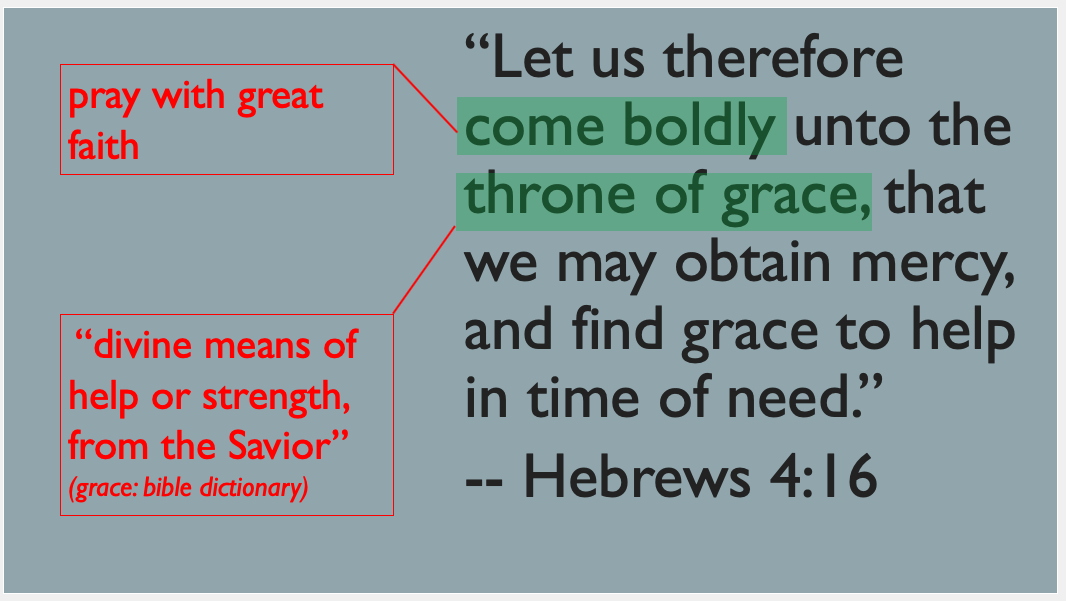
Before I was inspired to write this post, I had read Hebrews 1-6 and highlighted a number of scriptures. I went back, chose the scripture that was the most meaningful to me, and then began to ponder about it, and look up references to some of the lines in the scripture. The scripture I chose was Hebrews 4:16.

It says, "Let us therefore come boldly unto the throne of grace, that we may obtain mercy, and find grace to help in time of need." When we pray for help and act in faith, we "come boldly."

How are we bold? In April 1993, Gene R. Cook, of the First Quorum of the Seventy, said that we need to center our faith and hope upon Jesus Christ. We do this by being submissive and "seeking the intercession of the Lord more fully in our lives." We are bold by trusting in the Lord, boldly, as Enos did when he prayed all the day long. When we are bold, we open ourselves to the "throne of grace;" as the Bible dictionary defines grace, "divine means of help or strength from the Savior."


Application for children
Help the children to see that by studying further, they can find more in it. Another way to do this is to pick any church song, then look up the scripture on the same page as the song. See how knowing the song helps kids understand the scripture, or vice versa. 

"A Special Valentine with the Family Circus" is available on YouTube free in a four-part series. The climb I'm talking about is in Part 4, around the 3:33 minute mark. You can find it here. This is a great opportunity to talk about how just because we don't understanding something doesn't me we won't if we don't try a little harder. The kids were finally able to see PJ's art because:

a) They asked for help
b) They listened to the advice
c) They looked with their heart


Tuesday, October 22, 2019

New Testament Timeline

I made a little timeline for my Sunday School class to highlight what we have reviewed this year to date, but also to show the class the order in which Paul wrote his epistles (vs. the order they are put in the scriptures, which is based on longest to shortest). The numbers indicate the order in which Paul wrote the epistles that we have studied to date.


Thursday, September 19, 2019

Give Said the Little Stream

I've been thinking about 2 Corinthians 9:7, when Paul said, "for God loveth a cheerful giver." I am teaching some 6/7 year olds on Sunday about this topic, which resonates so strongly with me, especially for this age, where they start to do harder chores (than just putting their toys away), and when they are still learning to find joy in plain old, boring chores. I also see this being a great focus for a Primary Chorister activity, especially for a Primary Program song review.

We often talk about giving and charity in a separate context as cheerfully having a good attitude as we do life's boring chores, and I think they are closely related.

"Give Said the Little Stream" is a great way to talk about this lesson, whether taught at home in the family setting, by choristers on Sunday, or in small classes, like the one that I will be teaching.

Some thoughts on different ways to incorporate the song (which, by the way, was one of President Thomas S. Monson's favorite songs):

1. First of all, consider either singing "Give Said the Little Stream" together or watching this video that puts visuals with the song together.
> Whenever I sing this song with kids, I have them get up and spin or stand up and sit down whenever they sing the words "give" or words that start with "s" for bigger kids that know their letters.

2. Second, talk about what this song means:
> What are streams like? Are they still and quiet, or do they seem to dance and quietly go on their way? (the stream is "cheerful" ... and "God loveth a cheerful giver")
> How do streams bless the ground around it? (talk about the plants that grow, the animals that drink from it, etc.)

3. Ask the class to share examples of how we can give cheerfully


> You can make this into a fun activity by having children build something as they volunteer ideas. For example, it took me about a minute to cut out this flower in front of a meadow and stream. (The stream is feeding the flower.) Each child can put a petal on the flower as they share an example of one they can give cheerfully, or they can draw a petal that has something written on it already, and either have an opportunity to read it (with some help depending on the age) or elaborate on it.

> Older children can decorate and write instructions on petals to take home, so that they can build their own flower at home as they think about how they can cheerfully give. You can print out some examples or questions to give them ideas for what to write on the pedals:
- What chore does Mom or Dad have you do that you don't enjoy that you can do cheerfully this week?
- Can you say a prayer in the morning and have a prayer in your heart about having an opportunity to cheerfully give service?

> Choristers can put one song they are reviewing on each petal, briefly talk about what this song teaches, and talk about how as they are sharing their testimony through music during the Primary Program, they are giving as the stream gives. They can do this cheerfully with joy in their hearts about being missionaries preaching the gospel from their children's choir.

You can read more on my thoughts about what it means to be a cheerful giver here.


God Loveth a Cheerful Giver

I have been thinking a lot this week about this scripture, from a letter that Paul wrote to the people of Corin:

In 2 Corinthians 9:7, Paul said, "for God loveth a cheerful giver."

Photo by Elaine Casap on Unsplash


Giving with the Right Attitude
When I read this scripture, it resonated with me so strongly. I am such a big believer that our attitudes about how we do things can make such a big impact on how we experience life, especially in church service, where many of us voluntarily accept responsibilities that can take upwards of 20+ volunteer hours a week depending on the time of the year. We have leaders voluntarily taking their weekend to take youth camping, pianists that must learn and practice multiple songs to play in music programs, teachers that study meticulously to prepare and teach lessons, and so forth.

We can do these things with a joyful heart for the good we can do in the world, or we can waste those precious hours bemoaning our sacrifice and bringing misery to our homes, our friends, and those we serve. When we take the time to look outward, when we choose to find and create joy, we bring joy to ourselves as well as to others. After all, the leader gets to go camping, the pianist practices and keeps their abilities strong, and the teachers increase their personal intelligence as they study and prepare.

Dallin H. Oaks said, "Although those who serve out of fear of punishment or out of a sense of duty undoubtedly qualify for the blessings of heaven, there are still higher reasons for service." He says this in the talk, "Why Do We Serve," that he gave in October 1984. I highly recommend this talk, as I couldn't quote every paragraph as I wanted to. I'll just quote one more thing from Elder Oaks - now President Oaks - to whet your interest in this talk: "When the prophet Samuel was sent to Bethlehem to choose and anoint one of the sons of Jesse as a new king for Israel, the Lord told him to reject the first son, though he was a man of fine appearance. The Lord explained, "Look not on his countenance, or on the height of his stature, because I have refused him; for the Lord seeth not as man seeth; for man looketh on the outward apperance, but the Lord looketh on the heart. (1 Sam.16:7)"

I like that Elder Oaks clarifies that all service is good, but there is a higher way to serve. That higher way can benefit us personally when our hearts are open. I have a very good friend in the ward that was initially a stranger, that I wanted to serve by mainly trying to be a friend. She has been such a blessing in my life, and I am so grateful that I felt that I needed to get to know here better, because I have been so blessed by her friendship to me.

Changing Our Outlook
I know it's not always this simple but with baby steps, we can change our outlooks on how we serve.

Let me give an example with mowing the lawn and shoveling snow. Neither of these chores are  convenient - the lawn keeps growing, and the snow comes down whenever it wants to fall. I'm allergic to grass (terrible hay fever) and I get cold very easily. I can easily lay these burdens on my husband, and he would do them all. Or, I can just get the chores taken care of cheerfully, and know that it's a relief for him. I can think about how I love being outside, and with a busy schedule, it's  nice to have an excuse to be outside. I can think about how I used to pull my back a lot, and I'm excited that done right, both these activities are simple ways I can strengthen my back. I love to see the straight lines appear as I shovel through snow or mow a straight line. I love to know that I'm helping to make my part of the world a better place. I know I'm getting exercise, and that it's good for my lungs and heart to do these chore.

We've had opportunities to serve others while we've been outside mowing and shoveling, and accepted them as cheerful opportunities. I especially appreciate this because as we have been able to help neighbors with yard work and snow removal, we can remember when we first moved into the neighborhood, and were burdened with having just switched jobs and homes at the same time. We were so busy, and a kind neighbor mowed our lawn for us. Then another kind neighbor shoveled for us. It was nice to remember what that felt like when we returned the favor and "paid it forward."

This is a simple example but it takes us a step forward in everything we do in life - there are always cons, but when we focus on the pros, they can bring us so much joy.

Paul's Outlook
In the New Testament, Paul recites a list of things that has happened to him as he has preached the gospel in his travels - nearly 10,000 miles worth of travel, mostly by foot, in a twenty-five year period. He has been beaten, whipped, put in prison, threatened with death, etc. In 2 Corinthian 11:24-27 it says:

"24 Of the Jews five times received I aforty stripes save one.
25 Thrice was I abeaten with rods, once was I stoned, thrice I suffered shipwreck, a night and a day I have been in the deep;
26 In journeyings often, in perils of waters, in perils of robbers, in perils by mine own acountrymenin perils by the bheathenin cperils in the city, in perils in the wilderness, in perils in the sea, in perils among false brethren;
27 In aweariness and bpainfulness, in watchings often, in hunger and thirst, in fastings often, in cold and nakedness."
Understandably, then, Paul's attitude could be one of weariness. In fact, he even talks about a "thorn in the flesh" (2 Corinthians 12:7) that he wished for the Lord to remove from him (likely a reference to an infirmity that he is dealing with, though he doesn't specify) but then comments that the Lord has taught him that "for my strength is made perfect in weakness (2 Corinthians 12:8). His attitude, and his understanding that God loveth a cheerful giver propelled him through the important work he did while he was here on earth.

I want to close with the scriptures surrounding the quote about being a cheerful giver:

2 Corinthians 9:7-8:

"Every man according as he apurposeth in his heart, so let him give; not bgrudgingly, or of necessity: for God loveth a ccheerful dgiver.
And God is able to make all agrace abound toward you; that ye, always having all sufficiency in all things, may abound to every good work:"

You can read some of my thoughts on how to teach this concept to children in families, classroom, and during singing time here on Give Said the Little Stream.

Sunday, September 15, 2019

Come Follow Me for Sunday School: 1 Corinthians 14-16, 2 Corinthians 1-7

I taught in adult Sunday School today. It's my nature to research deeply on a topic that interests me, and take notes, so don't think I'm too crazy but I had 63 slides for today's lesson. Obviously, I didn't use every slide because that would mean spending less than a minute per slide during class. I also didn't read every item on every slide. I like to jump around and bring up relevant slides, and highlight something that is on the slide to encourage class discussion, so that we are edifying each other. The slides are a supplement to the discussion, not the focal point. So ... for those that were in my class and wanted to read more deeply what was actually on each slide, I've picked 11 out of 63 slides to share today. For those that aren't in my class, enjoy! I wish I could share all the wonderful comments and insights that really make the class.

These slides give some background on Paul and Joseph, and the context of writing to the people in Corinth (the more you understand about the writer of Corinthians, Paul, and what the people and city were like, the more you can understand his complex writing style):


Here are some of the topics that we discussed from 1 Corinthians 14-16 (we can and should edify each other, we can comfort our loved ones by teaching about the resurrection):


Here are some of our discussion topics from 2 Corinthians 1-7 (our trials can strengthen and bless us, we can forgive, godly sorrow is a blessing that leads to repentance and the healing power of the atonement):


I shared a video called "My Burden was Made Light" but only around the 3.40 minute mark to about the 6 minute mark: https://www.churchofjesuschrist.org/media-library/video/2010-07-14-forgiveness-my-burden-was-made-light?lang=eng because I thought it really helped give a valuable perspective on forgiveness, that this man, who had half of his family killed by a drunk driver, forgave because the atonement of Christ allowed him to and gave him the strength to forgive, and he wanted that so he could move on with his two surviving sons. 

I used two sources to make the below slide. The green circles are from the second source. Everything else is from President Uchtdorf's 2013 talk.


Thursday, September 12, 2019

Understanding Saul (Who Became Paul) Helps us Love and Teach Much of the New Testament

(Note for choristers: song recommendations at the end.)

Paul is the author of a good chunk of the New Testament after the Four Gospels and Acts, of which he plays a big role. He authored many of the books because they are the epistles (letters) that he wrote to people in various areas, in order from his longest epistle (Romans) to his shortest epistle. In many cases, these were people that he wanted to talk to, but he wrote letters until a time that he could go visit them, since he couldn't easily or quickly travel to these different locations, and often, there was work to be done where he was already at, or it was dangerous for him to travel to certain areas.

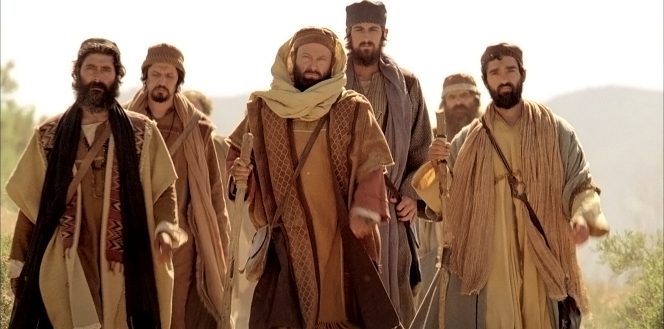
Acts 22, Saul walking with his company to Damascus

When I think of Paul's epistles, I think of King Benjamen in the Book of Mormon, and how when he spoke from a tower, his words were written down so that those who were further and not within reach of his voice would be able to "hear" his message. I also think about General Conference today, and how the words from our prophet and leaders can be broadcast around the world, and also printed into the Ensign in multiple languages so that all can partake of these wonderful messages that teach and uplift. Back then, Paul had to write a letter (often with the help of a scribe), then send someone (often his scribe, it appears) to deliver the letter. 

I'm fascinated by a few aspects about Paul though. There were many men and women in the scriptures who willfully chose evil, and who did not change their ways before they died. For instance, Lot's wife, who left the evil city of Gomorrah, but looked back longingly and was turned into a pillar of salt. Then there's Saul (who became Paul), who the Lord saved to become a missionary for the gospel, and even went to extra efforts to save. Rather than letting him die a foolish man, "breathing out threatenings and slaughter against the disciples of the Lord" (Acts 9:1), he speaks to Saul, saying "Saul, Saul, why persecutest thou me?" (Acts 9:4). After this experience, Saul is unable to see for three days. The Lord then sends Ananias to heal him. Ananias says, "Lord, I have heard by many of this man, how much evil he hath done to they saints at Jerusalem: And here he hath authority from the chief priests to bind all that call on thy name." (Acts 9:13-14). In other words, Ananias seems to be thinking, "Um, he's evil. He hates good. Are you sure you want to give him his sight back, and give him more opportunity to destroy followers of God?"

The Lord answers, "Go thy way: for he is a chosen vessel unto me, to bear my name before the Gentiles, and kings, and the children of Israel: For I will shew him how great things he must suffer for my name's sake." (Acts 9:15-16)

This fascinates me. Why would the Lord save Saul and not Lot's wife? Was it because unlike Laman and Lemuel from the Book of Mormon (1 Nephi), the Lord knew that Paul would listen when given the opportunity to learn? (And in fact, the Lord did send angels to speak to Laman and Lemuel - and then they didn't listen.) (Jeffrey R. Holland has an excellent take on Lot's wife here, but that's a different topic, so click on the link if you want to read further.)

Also, how could Saul have been taught by Gamaliel but be so unlike Gamaliel in fairness? In Acts 22:3, it says that Paul was "brought up in this city at the feet of Gamaliel." Gamaliel was a respected Pharisee, a lawyer ("a doctor of the law"), and unlike some of the Pharisees in the scripture, he didn't seem to persecute others, but rather the opposite. In Acts 5:34-39, Gamaliel saves Peter and John from being stoned to death, not because he sides with Peter and John but because he reasons to the others that Peter and John are either fake, and their preachings will "come to naught," or they are of God, and, "if it be of God, ye cannot overthrow it; lest haply ye be found even to fight against God."(Acts 5:39). I love his reasoning here. If we could think the same way, how much fighting and anguish could we prevent in the world? 

If Gamaliel was so reasonable, why was Paul so seemingly vengeful, where he was actively looking for people to throw in jail?

In "Paul, Untiring Witness of Christ," from August 1999, David Rolph Seely and Jo Ann H. Seely share, "A zealous Pharisee, Saul saw it as his religious duty to protect Judaism from apostasy. Because the Pharisees considered Christianity a heretical sect of Judiasm, he viewed his persecution of Christians as an attempt to defend Judaism."

On the road to Damascus, Saul underwent a great change. From defending Judaism to realizing that he was still fighting for God but he was going about it in the wrong way, with the wrong doctrine. He mourned the decisions he had made that hurt innocent people and he loved passionately the children of God, which is all men. He wanted to save everyone, and he served a life-long mission after that experience on Damascus, trying to prepare people to return to the Kingdom of Heaven when they left this mortal world.

He was deeply mournful of his earlier bad works, and spent the rest of his life helping others through missionary work.

In 1 Corinthians 15:9-11, he calls himself the least of the apostles because, "I persecuted the church of God." He then goes on to say, "But by the grace of God I am what I am; and his grace which was bestowed upon me was not in vain; but I laboured more abundantly than they all; yet not I, but the grace of God which was with me."

In 2 Corinthians 2:4, he said, "For out of much affliction and anguish of heart I wrote unto you with many tears; not that ye should be grieved, but that ye might know the love which I have more abundantly unto you."

When you understand that Paul was teaching something he was passionate about because he cared, and that what he was teaching was new for him and new for the people he taught - how does that change how you read Romans, Corinthians, and all of his other epistles? His language can still be tough to read at times but that context along strengthens the understanding of the topics and the gravity in which he focuses on themes like forgiveness, why our trials can be a blessing (2 Corinthians 1:37; 4:6-10, 17-18, 7:4-7), not judging others (Romans 14), and more.

Teaching Children Through Music
Share some of the background on Paul's story, then let children draw from some topic cards. Each card can contain a simple scripture and topic that Paul taught about - which can be associated with a song for children to sing in review.

Examples:

1 Corinthians 14:3 - Paul taught us to teach
Sing "Teach Me to Walk in the Light"

1 Corinthains 15:22 - In Christ, all are made alive
Sing "I Know My Father Lives"

1 Corinthians 15:40-42 - The Celestial Kingdom
Sing "I Lived in Heaven"

2 Corinthians 1:3-7 - Our trials can be a blessing
Sing "He Sent His Son"

2 Corinthians 2:10 - Forgive others
Sing "I'm Trying to Be Like Jesus"